
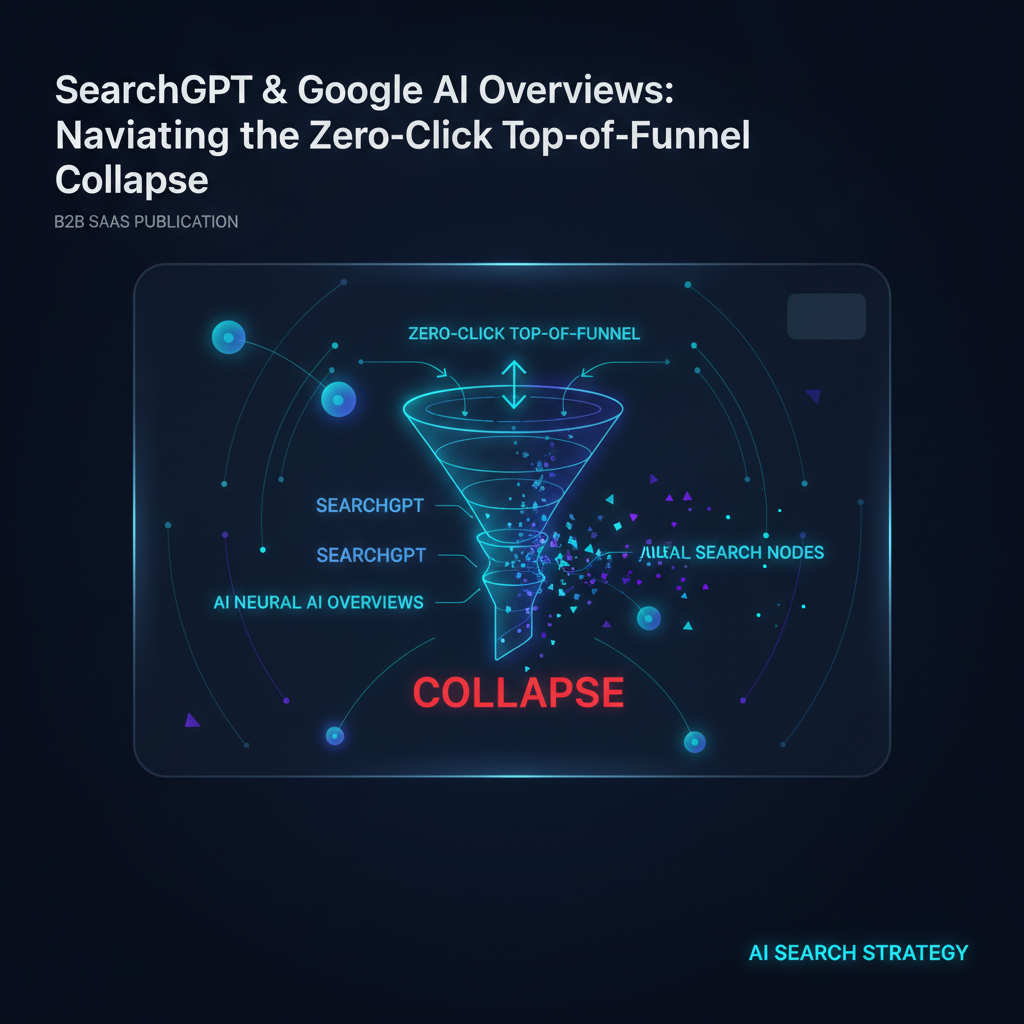
SearchGPT & Google AI Overviews: Navigating the Zero-Click Top-of-Funnel Collapse
Traditional search once rewarded brands that ranked well, earned the click, and converted attention on-site. That model is weakening fast. As Google AI Overviews, SearchGPT-style interfaces, Perplexity, and Gemini compress discovery into answer layers, B2B SaaS teams are losing top-of-funnel traffic even when their expertise still shapes the buyer journey.
The strategic problem is not just declining clicks. It is declining visibility inside the measurable web. When an enterprise buyer gets a synthesized answer without visiting your site, your brand can influence the decision while receiving little or no session data in return. That creates a new operating reality: marketing teams must optimize not only for ranking, but for citation, extraction, and answer-surface presence.
The old model
- Rank for a target keyword
- Win the click from the SERP
- Drive a site visit
- Capture demand on-page
The new model
- Become a trusted source entity
- Get parsed by answer engines
- Earn citations in AI summaries
- Influence demand before the click
Why zero-click changes the economics
Zero-click behavior is not new, but AI answer layers intensify it. Instead of sending users to ten blue links, the interface increasingly resolves informational intent directly. For B2B SaaS publishers and vendors, that means classic top-of-funnel content can still be useful to the market while producing fewer attributable visits, fewer assisted sessions, and weaker first-party behavioral signals.
This collapse matters because top-of-funnel content has historically done more than generate traffic. It educated buying committees, framed category language, and introduced solution criteria that later shaped commercial evaluation. If that educational function now happens inside AI-generated summaries, then the value of content depends less on click-through rate alone and more on whether your expertise is being surfaced, quoted, and trusted by the engines mediating discovery.

A clearer operating framework
To make the shift more actionable, the funnel should be understood as a visibility transition rather than a simple traffic decline.
Search visibility is no longer synonymous with website visitation. In AI-mediated discovery, influence can rise while clicks fall.
Traditional SEO path
- Query entered in search
- Ranked result displayed
- User clicks through
- Brand earns session data
- Retargeting and attribution begin
AI overview path
- Query entered in answer engine
- Multiple sources are synthesized
- User gets summary in-interface
- Brand may be cited but not clicked
- Attribution becomes partially invisible
What B2B SaaS teams should do next
First, stop reading traffic decline in isolation. If branded authority, engagement quality, and downstream pipeline remain stable, lower informational click volume may reflect interface change rather than content failure.
Second, structure content for extraction. Lead with direct answers, use precise terminology, maintain clean headings, and publish comparison data in formats that retrieval systems can parse efficiently.
Third, expand performance measurement beyond sessions. Track citation frequency across answer engines, monitor whether your core claims are represented accurately, and evaluate whether AI summaries position your brand inside the shortlist that matters before a buyer ever reaches your site.
Conclusion
The top of funnel is not disappearing. It is being abstracted behind AI interfaces that compress discovery, summarize expertise, and reduce the number of measurable visits reaching publishers and vendors. The brands that adapt fastest will be the ones that treat zero-click not as a reporting anomaly, but as a structural shift in how authority is surfaced and demand is shaped.
Disclaimer: ai sensi dell’EU AI Act, questo articolo è stato scritto con il supporto dell’AI.
