
For nearly two decades, B2B SaaS marketing leaders built their go-to-market strategies on a comfortable, highly scalable assumption: that demand creation could be outsourced to paid capture mechanisms at the bottom of the funnel. The operational playbook was universally accepted across venture-backed boardrooms. Pour capital into Google Search ads for high-intent software keywords, bid aggressively on competitor brand terms, gate every whitepaper behind multi-field lead forms, and route every resulting download directly to sales development representatives (SDRs) for immediate phone and email outreach. Marketing teams measured success through cost-per-lead (CPL) and marketing-qualified lead (MQL) volumes, celebrating short-term demand capture performance.
In 2026, this legacy demand capture model has collided with an unforgiving economic reality. As cost-per-click (CPC) rates on high-intent software keywords surged over 140% and enterprise buyers systematically erected defensive barriers against unsolicited sales communications, bottom-of-funnel bidding entered a cycle of diminishing returns. Chief Marketing Officers find themselves caught in a demand capture paradox: spending significantly more budget each quarter to compete over an increasingly narrow, highly transparent slice of active buyers, while completely starving the un-gated, category-building channels where enterprise buying decisions are actually formed.
The Structural Collapse of Bottom-of-Funnel Bidding
The core strategic flaw of over-indexing on bottom-of-funnel demand capture lies in its fundamental misunderstanding of modern enterprise buying behavior. Paid search ads, retargeting banners, and review site listings do not create commercial intent; they merely attempt to intercept buyers who have already determined their requirements and compiled a shortlist of vendors. When a VP of Infrastructure or Head of Data Engineering finally searches for a specific category keyword or clicks a sponsored search result, they are not starting their evaluation process—they are finishing it.
By forcing potential clients through rigid form gates and immediate sales qualification workflows, traditional demand capture tactics actively alienate modern decision-makers. Buying committees desire self-directed, asynchronous research environments. When presented with gated whitepapers or aggressive demo-booking popups, high-intent prospects simply exit the site and consume un-gated technical benchmarks on peer Slack groups, Reddit discussions, or third-party analysis platforms. Consequently, marketing teams that double down on paid demand capture find themselves overpaying for low-quality lead forms while remaining completely blind to the multi-stakeholder intent building within their target accounts.
Quantifying the Intent Gap Across Industry Benchmarks
The divergence between software-reported demand capture metrics and actual revenue creation is rigorously documented across top-tier enterprise B2B benchmarks and analytics frameworks.
Recent buyer behavior research from Gartner and Forrester underscores the dramatic self-sufficiency of modern purchasing committees. Gartner’s enterprise buyer benchmarks reveal that 75% of B2B SaaS buyers now prefer a rep-free evaluation experience, with buying groups spending only 17% of their total evaluation window meeting directly with vendor sales representatives. Simultaneously, Forrester’s revenue operations data demonstrates that complex software purchases now involve an average of 11 to 14 cross-functional decision-makers spanning IT, security, finance, legal, and operational business units. Expecting a single lead form submission from one manager to represent the buying intent of a 14-person executive committee is an operational fantasy.
This reality is reinforced by SaaS capital efficiency benchmarks published by Bessemer Venture Partners and OpenView. Their 2026 state-of-SaaS benchmarks show that average Customer Acquisition Cost (CAC) payback periods for enterprise SaaS companies expanded to a record 28.6 months. In a macroeconomic climate governed by net revenue retention (NRR) targets and strict capital allocation, spending $300 to $500 per click to fight for bottom-of-funnel keyword placements is fundamentally unviable.
Attribution and pipeline intelligence research from revenue analytics platforms Dreamdata and HockeyStack—analyzing over 40,000 enterprise B2B sales cycles—further illuminates the dark funnel dynamic. Their datasets reveal that accounts closing six-figure annual contract value (ACV) deals engaged with an average of 18 un-gated research touchpoints across podcasts, dark social, and technical documentation prior to initiating formal contact. Crucially, legacy multi-touch attribution (MTA) models misallocated over 83% of total pipeline credit to final-click search ads or direct domain visits, completely masking the category-building content that generated account trust.
Furthermore, intent realization data from 6sense, Demandbase, Factors.ai, and Clay proves that at any given moment, only 3% to 5% of target accounts within an Ideal Customer Profile (ICP) are actively in-market for software solutions. Top-quartile GTM organizations that reallocated marketing capital from passive search bidding to active first-party account signal realization achieved a 3.4x increase in qualified pipeline velocity and reduced CAC payback timelines by 38%.
The Architecture of Un-Gated Intent Acceleration
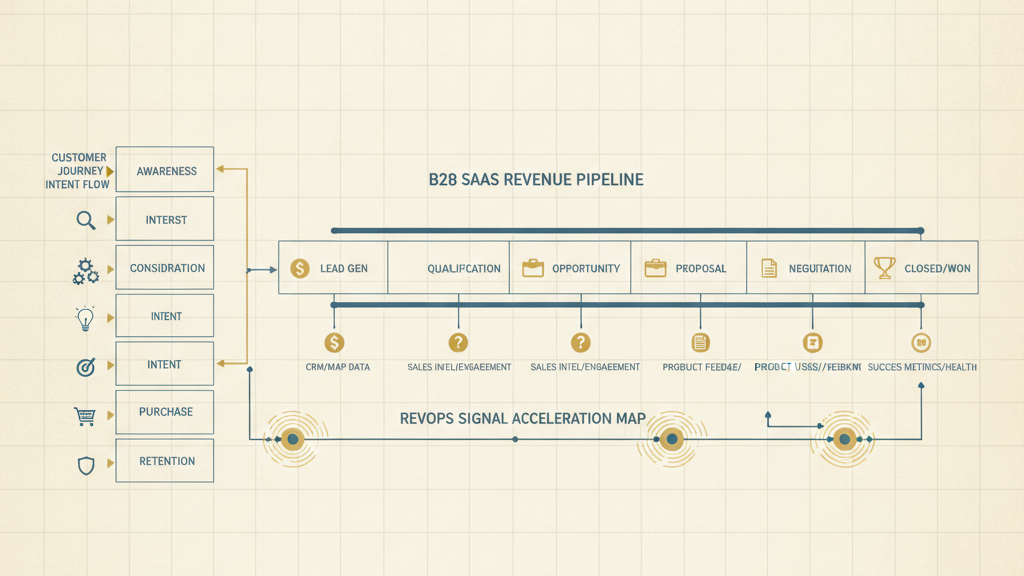
To break free from the demand capture trap, forward-thinking Revenue Operations and Marketing executives are engineering a unified Un-Gated Intent Acceleration Architecture. Rather than forcing prospects through lead form gates, this operational framework focuses on distributing high-value technical assets frictionlessly while capturing first-party account telemetry across three core operational layers:
- Frictionless Demand Creation & Category Authority: Eliminating form barriers from whitepapers, ROI models, architecture blueprints, and API documentation. Content is purpose-built for native consumption across executive podcasts, LinkedIn dark social, and specialized industry communities to establish undisputed category leadership.
- First-Party Account De-Anonymization & Telemetry: Deploying cookieless reverse-IP lookup engines, domain-level web telemetry, and account engagement scoring to identify target ICP enterprises actively consuming technical documentation or pricing tiers in real time.
- Signal-Driven RevOps Orchestration: Integrating intelligence stacks like Clay, 6sense, and HubSpot to track account engagement velocity. When multiple stakeholders from a target enterprise exhibit coordinated research spikes within a 7-day window, automated RevOps workflows trigger personalized, context-aware outreach from senior account executives.
Strategic Operational Blueprint for GTM Executives
Transitioning an enterprise SaaS go-to-market engine from reactive bottom-of-funnel bidding to proactive intent acceleration requires three decisive strategic pivots:
- Strategic Pivot 1: Shift Marketing Capital from Paid Capture to Un-Gated Category Distribution. Reallocate 40% to 50% of legacy paid search and display budgets into un-gated research reports, executive podcasts, and native content distribution. Measure marketing impact by total account engagement within target ICP lists rather than isolated ad clicks.
- Strategic Pivot 2: Replace MQL Volume Quotas with Multi-Stakeholder Account Velocity. Discontinue evaluating marketing performance on raw lead download volume. Re-align executive KPI dashboards around account research depth, intent surge frequency, and pipeline conversion speed across target accounts.
- Strategic Pivot 3: Arm Sales Development with Real-Time Intent Intelligence. Stop forcing SDRs to cold-call contacts who completed isolated whitepaper downloads. Instead, equip reps with account signal dashboards that highlight multi-stakeholder research activity, ensuring outreach is hyper-personalized, consultative, and perfectly timed.
The Bottom Line for GTM Leaders
If I had to boil down what this data means for VPs of Marketing and GTM leaders preparing for their next fiscal growth cycle, it comes down to three operational imperatives:
- Abandon the obsession with bottom-of-funnel bidding wars. Recognize that bidding on high-intent search terms merely captures demand that has already matured. Stop overpaying for keywords while ignoring the category-building channels where decisions are actually forged.
- Un-gate your highest-value technical content to maximize brand mindshare. Give enterprise buying committees complete freedom to evaluate your methodology, product architecture, and pricing asynchronously across un-gated channels and peer networks.
- Construct a unified RevOps engine that converts first-party intent signals into timely sales engagement. Replace volume-driven lead routing with account-level signal acceleration. When a target enterprise displays active research spikes, equip your sales team with context-rich intelligence to engage buyers at the precise moment of commercial readiness.
In an enterprise SaaS landscape governed by rep-averse buyers and rigorous capital discipline, sustainable growth is not achieved by capturing isolated clicks, but by establishing the un-gated authority and real-time intent intelligence that earns trust long before the buyer ever reaches out.
Disclaimer: This article was created with the assistance of Artificial Intelligence tools to support research, structure, and editorial drafting, in full compliance with AI transparency principles and the EU AI Act.
