
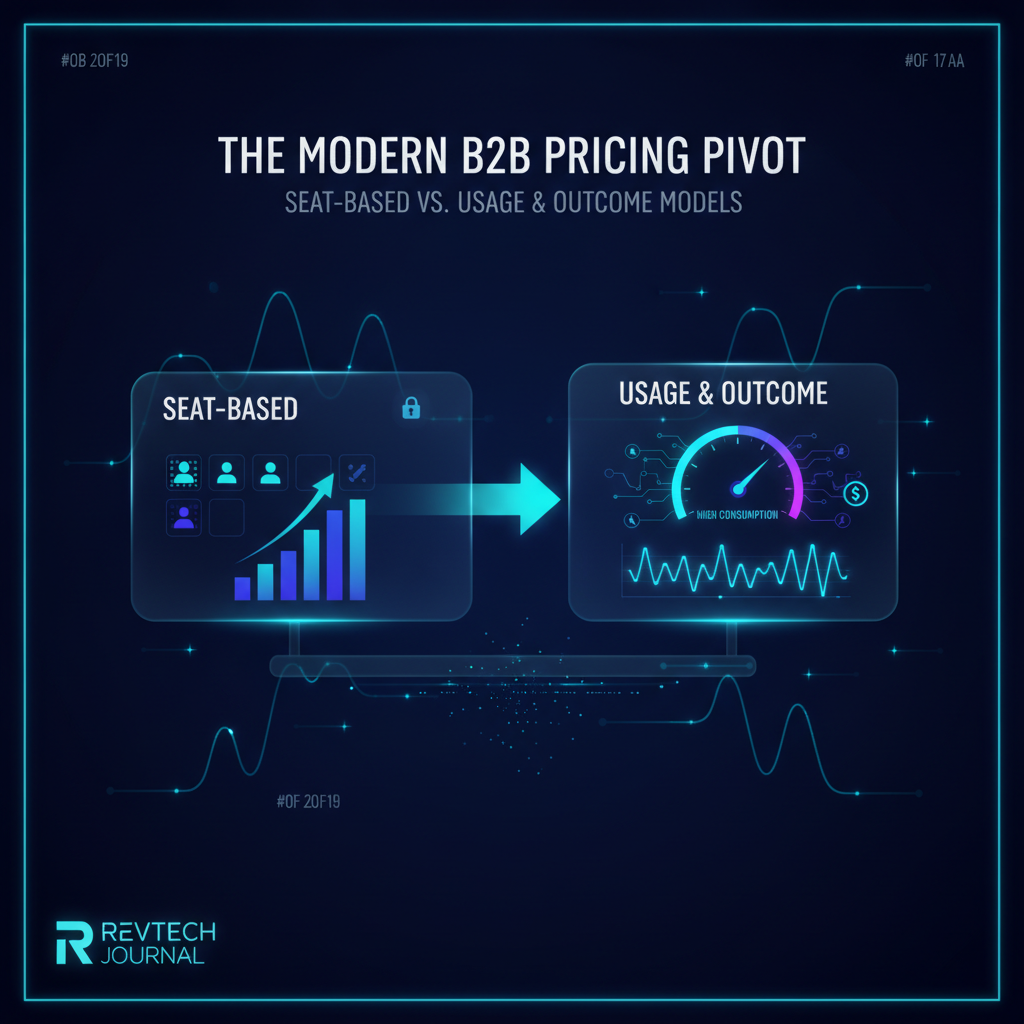
Per-seat SaaS pricing is running out of road. For nearly two decades, charging per user head was the default monetization framework for software vendors. It made financial planning simple and aligned neatly with headcount expansion.
Generative AI and automated workflows changed that math completely.
When an AI-driven platform makes an enterprise operational team 60% more efficient, traditional seat-based models actively punish the software vendor. The customer achieves higher operational throughput using significantly fewer human seats, leading to shrinking contract values at renewal despite massive value creation.
Scaling B2B SaaS companies are fundamentally restructuring monetization architectures, shifting away from user counts toward consumption-based and outcome-aligned pricing models.
Pricing model shift
Traditional seat-based pricing
- Charges for user access
- Revenue tied to headcount
- Efficiency gains can shrink contract value
Modern usage and outcome pricing
- Charges for system utility or results
- Revenue scales with delivered value
- Expansion can grow without adding seats
1. The Spectrum of Modern SaaS Monetization
Decoupling price from seats isn’t a one-size-fits-all transition. Modern GTM strategy categorizes monetization models into three distinct operational frameworks based on customer value alignment:
Pure Consumption (Usage-Based)
Revenue scales directly with measurable platform utility or infrastructure compute. Snowflake charges per compute credit, Twilio charges per API endpoint invocation, and Datadog charges per gigabyte of ingested telemetry. The buyer pays strictly for what they process, lowering top-of-funnel barrier to entry.
Hybrid Multi-Metric
A platform access fee covers baseline governance, user management, and core administrative capabilities, coupled with usage tiers for high-cost processing vectors. A platform might charge a $20,000 baseline platform fee plus $0.05 per AI task executed or workflow automated.
Outcome-Based Pricing
Monetization maps directly to verified business results. Performance marketing engines charge a percentage of incremental ad spend recovered, while automated collections platforms charge a fee on actual capital recovered. This model yields the highest net expansion rates but requires bulletproof data verification layers.
Enterprise monetization spectrum
Pure consumption
Compute, API, or data-volume pricing.
Hybrid multi-metric
Platform fee plus variable usage tiers.
Outcome-based
Pricing tied to verified business impact.
Shared objective: stronger value alignment and uncapped NRR potential.
2. Managing Financial Predictability and CFO Friction
The primary executive objection to usage-based pricing is revenue volatility. Enterprise buyers demand budget predictability for their annual planning cycles, and institutional investors demand recurring ARR visibility. Pure usage models can create unpredictable quarter-over-quarter revenue swings based on customer seasonality.
Mitigate this volatility using annual minimum commitments with pre-paid drawdowns.
Under this structure, enterprise buyers purchase an annual commit baseline payable upfront at a discounted rate. They draw down against this pool throughout the year. If consumption exceeds the baseline commitment, usage scales at standard overage rates.
This model secures guaranteed upfront annual recurring revenue while preserving uncapped expansion upside as platform consumption scales.

3. Operational Implementation: Navigating the Customer Transition
Migrating an existing customer base off legacy seat-based pricing requires careful change management. Changing pricing mechanics unexpectedly creates immediate churn risk.
- Deploy model dual-run tracking: Roll out internal usage meters to calculate customer consumption profiles quietly before making public pricing adjustments.
- Launch usage dashboard transparency: Build real-time consumption dashboards directly into the product workspace, giving administrative buyers complete visibility into usage patterns and projected burn rates.
- Establish legacy transition windows: Grandfather existing accounts on seat-based models for 12 months, providing usage calculators that demonstrate how transitioning to a consumption or hybrid model aligns directly with their unit economics.
4. Primary Growth Metric: Net Revenue Retention Expansion
Moving away from seat-based constraints unlocks compounding Net Revenue Retention. Track customer expansion velocity using the standard cohort NRR equation:
NRR % = ((Starting ARR + Expansion ARR – Contraction ARR – Churn ARR) / Starting ARR) × 100
Usage-based and hybrid pricing models routinely generate NRR benchmarks between 125% and 140% because expansion scales automatically with platform consumption, eliminating the need to negotiate additional user licenses every time a customer grows.
Disclosure ai sensi dell’EU AI Act: questo contenuto è stato sviluppato con il supporto di strumenti di intelligenza artificiale e revisionato per la pubblicazione editoriale.
