
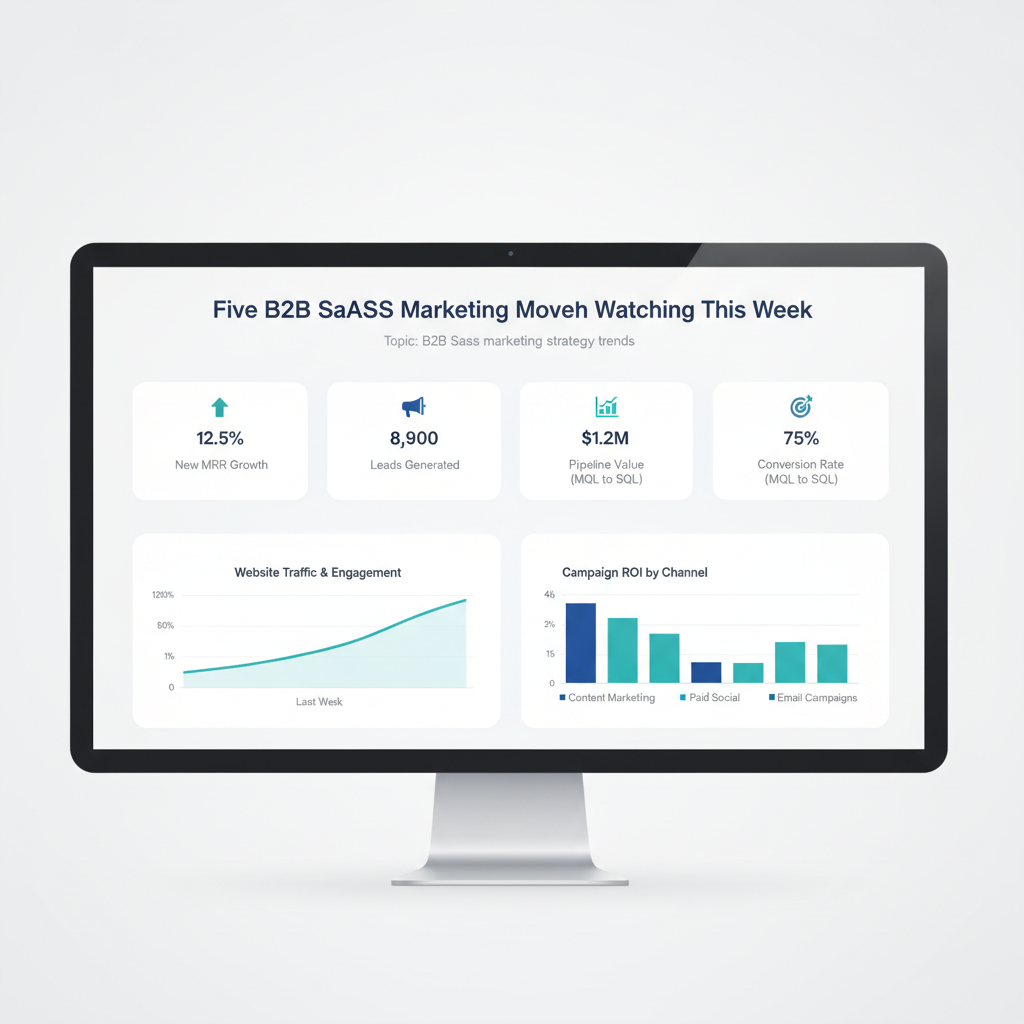
Five B2B SaaS Marketing Moves Worth Watching This Week
Most weekly roundups list news. This one filters for signal, the handful of moves that actually change how B2B SaaS marketing and growth teams should be thinking, not just what happened.
What Counts as Signal This Week and Why Does It Matter for B2B SaaS?
A weekly signal is a market move, product shift, or data point that changes a B2B SaaS marketing team’s near-term priorities, not just a headline worth skimming. The difference matters because most marketing teams are already drowning in news feeds and newsletters. What they lack is filtering, a short, opinionated read on which five things out of five hundred actually deserve a Monday morning conversation with the team.
This week’s signals span pipeline strategy, search visibility, and category positioning. [Insert Stat/Case Study here: aggregate data point summarizing this week’s broader B2B SaaS marketing trend].
How This Week’s Five Moves Solve Specific Planning Problems
Each of these is chosen because it should change a specific decision on your roadmap, not just your reading list.
- [Insert Move 1: e.g., a major SaaS platform shift in AI Overview citation behavior], relevant if your GEO strategy still assumes traditional ranking behavior.
- [Insert Move 2: e.g., a shift in a leading SaaS company’s pricing or packaging model], relevant if your positioning depends on a stable competitive pricing landscape.
- [Insert Move 3: e.g., a notable executive move or funding event in the category], relevant for account-based teams tracking buying committee changes.
- [Insert Move 4: e.g., a new benchmark report on B2B buyer behavior], relevant for teams recalibrating demand capture versus demand creation budget splits.
- [Insert Move 5: e.g., a platform algorithm or policy change affecting organic or paid visibility], relevant for anyone with meaningful spend or dependency on that channel.
This structure gives readers:
- A five-minute read that replaces an hour of scattered scrolling
- A clear “why this matters to you” framing for every item, not just a summary
- A consistent weekly cadence that builds habitual return readership
- A natural bridge to deeper pieces, since any of the five can be expanded into a full Monday through Thursday article in a future week
This Week’s Signals vs. a Standard News Digest
- Selection criteria: Standard News Digest — Recency and volume; Weekly Signal Roundup — Relevance to marketing decisions
- Framing: Standard News Digest — What happened; Weekly Signal Roundup — Why it matters and what to do about it
- Length per item: Standard News Digest — Headline plus link; Weekly Signal Roundup — Two to three sentences of context
- Reader outcome: Standard News Digest — Awareness; Weekly Signal Roundup — A prioritization or planning input
- Cadence value: Standard News Digest — Passive consumption; Weekly Signal Roundup — Active weekly planning input
Step-by-Step Guide to Building Your Own Weekly Signal Process
- Set a weekly scan window, a fixed one to two hour block to review category news, competitor moves, and platform changes.
- Filter aggressively, keeping only items that would change a real decision, not just items that are interesting.
- Write the “why it matters” line first, before the summary, to force relevance over recap.
- Rank the five by urgency, not by chronology, so the most decision-relevant item leads.
- Close the loop, revisiting past signals a month later to note which ones actually mattered, building credibility over time.
Key Challenges and How to Overcome Them
The hardest part of a weekly format is resisting filler when the week is genuinely slow. Publishing five weak items to hit a quota erodes trust faster than publishing four strong ones and being transparent that it was a quiet week. The second challenge is staying opinionated rather than neutral, since a roundup that only summarizes without taking a position on why something matters reads exactly like every other digest in a crowded inbox.
Conclusion and Next Steps
A weekly signal roundup earns its place in a reader’s inbox by doing the filtering work they do not have time to do themselves. The goal is not comprehensiveness, it is relevance. If you are building your own version of this format, start with the discipline of writing the “why it matters” sentence before the summary, it is the single habit that separates signal from noise.
