
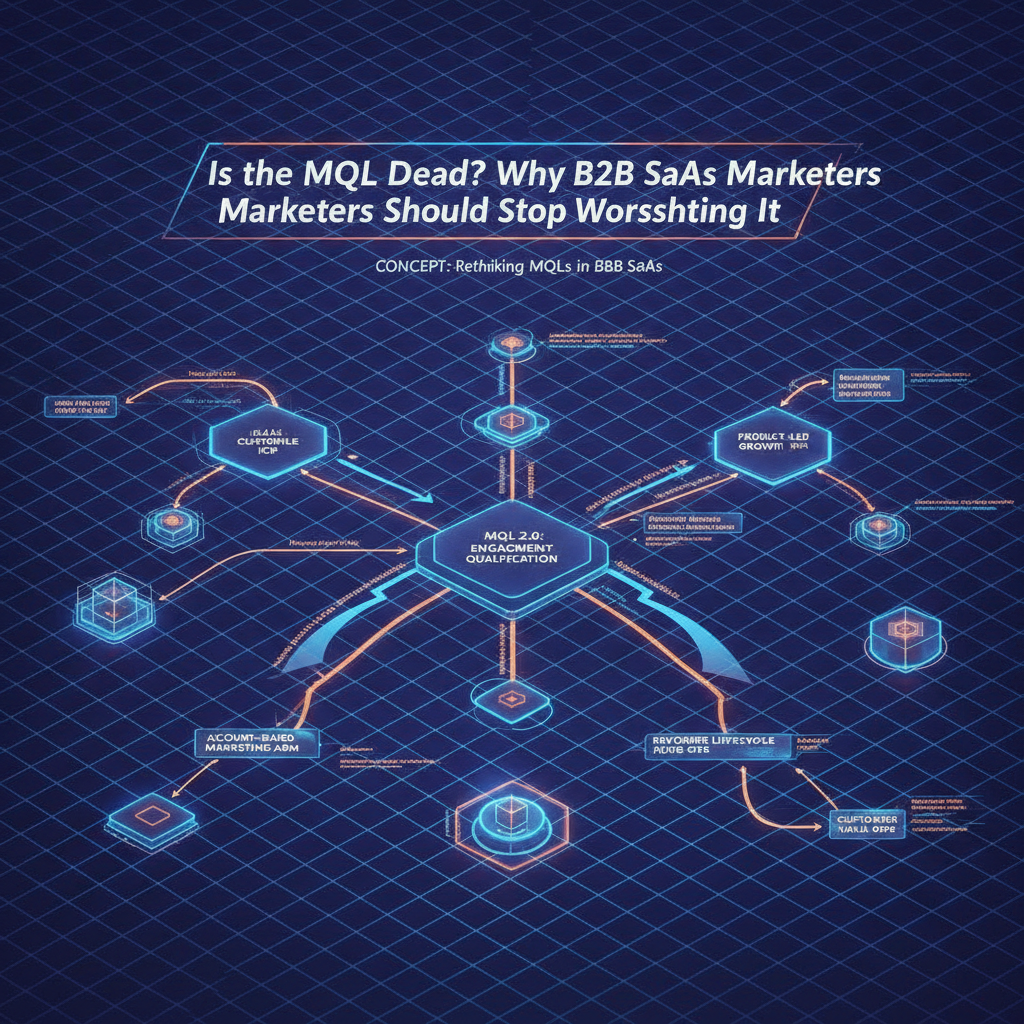
Is the MQL Dead? Why B2B SaaS Marketers Should Stop Worshipping It
For over a decade, the Marketing Qualified Lead has been the north star of B2B SaaS marketing. Dashboards are built around it, quotas are set on it, entire org structures exist to hand it off from marketing to sales. And yet, walk into almost any revenue team meeting today and you’ll hear the same complaint: “we hit our MQL number, but pipeline didn’t move.”
That gap is not a fluke. It’s a structural problem with the metric itself.
The Proxy Problem
An MQL was never meant to be a business outcome. It was designed as a proxy, a rough signal that someone showed enough interest to be worth a sales conversation. The trouble starts when organizations treat the proxy as the goal. Marketing teams get very good at generating MQLs, because the definition of “qualified” is entirely within their control. Lower the lead score threshold, count a gated ebook download as intent, and the number climbs. Whether that lead ever becomes revenue is a separate question that the MQL count simply doesn’t answer.
This is how you end up with marketing declaring victory on volume while sales quietly stops working the list.
Why It Breaks Down Specifically in B2B SaaS
The MQL model assumes something that used to be closer to true: a single person, researching alone, moving through a funnel, eventually raising their hand. Enterprise SaaS buying doesn’t work that way anymore.
Deals are decided by committees of six, ten, sometimes fifteen stakeholders. The economic buyer, the technical evaluator, the end user, procurement, security, legal — each interacts with your content differently, at different times, and most of them never fill out a form. Scoring the behavior of one individual and calling it “qualification” ignores the reality that you’re selling into a group decision, not converting a lead.
Long, multi-touch, multi-threaded cycles also mean that a person can be genuinely interested three months before their company has budget, and genuinely ready to buy without ever tripping a scoring threshold. The MQL captures neither case well.
What to Track Instead
None of this means intent signals are worthless. It means the unit of analysis needs to shift from the individual lead to the account.
- Account-level intent: aggregate signal across every contact at a target account, not just the one who filled out a form
- Pipeline generated and pipeline influenced: did marketing activity contribute to an opportunity sales actually opened, not just a lead sales was handed
- Win rate and cycle time on marketing-sourced or marketing-influenced deals: quality shows up here, volume metrics hide it
- Engagement depth across the buying committee: how many distinct roles at an account are engaging, not how many forms one person filled out
These metrics are harder to report on a weekly dashboard, and they require marketing and sales to actually agree on what “qualified” means at the account level. That friction is the point. It forces both teams to optimize for the same outcome instead of two different scoreboards.
The MQL Isn’t Worthless, It’s Just Not the Point
The MQL can still be a useful internal signal for prioritizing SDR outreach, especially when it’s built on real behavioral data rather than demographic checkboxes. The mistake is elevating it to a north star KPI, reported to leadership as if it were a proxy for revenue.
If your MQL count is going up and your pipeline isn’t, that’s not a top-of-funnel problem. It’s a measurement problem. And in B2B SaaS, where the real unit of the sale is the account and not the individual, it might be time to retire the metric that made sense for a simpler buying process and never quite caught up to this one.
