
For more than a decade, Chief Marketing Officers and Revenue Operations leaders across the enterprise SaaS ecosystem operated under a foundational belief: that commercial success was a linear function of Marketing Qualified Lead (MQL) volume. Revenue organizations constructed elaborate point-based lead scoring systems inside Marketing Automation Platforms (MAPs), assigning point values whenever an individual downloaded a whitepaper, attended a webinar, or clicked an email campaign. Once an individual contact crossed an arbitrary threshold—say, 50 points—they were immediately deemed “sales-ready” and pushed to Sales Development Representatives (SDRs) for aggressive outbound sequences. But as buyers evolved and sales cycles elongated, this legacy approach created a pervasive operational disconnect: sales teams were flooded with low-intent contacts, while active enterprise buying committees evaluated software completely out of sight.
The Fallacy of Individual Lead Scoring in Complex Enterprise SaaS
The structural failure of point-based lead scoring stems from a fundamental misunderstanding of modern enterprise purchasing behavior. Lead scoring models evaluate individual contact actions in isolation, operating under the assumption that a single contact’s digital clicks reflect organizational intent. In reality, modern enterprise B2B SaaS purchasing decisions are never made by solitary individuals. Buying decisions are executed by multi-stakeholder buying committees that navigate complex internal risk assessments, security evaluations, and budget sign-offs.
When an SDR reaches out to a junior analyst simply because they downloaded an ungated PDF or clicked a newsletter link, the interaction is almost universally met with friction. The analyst was seeking educational content, not evaluating software vendor contracts. Meanwhile, executive decision-makers within that same target account—the VP of Infrastructure, Chief Security Officer, and VP of Finance—are actively discussing technical architecture options across peer Slack communities, industry forums, and private executive advisory networks. By relying on point-based lead scoring, GTM teams burn brand equity on cold contact outreach while remaining oblivious to true account-level buying momentum.
Quantifying the Dark Funnel and the Intent Signal Gap
The extent of this operational misfire is thoroughly validated by empirical data across top-tier B2B benchmark studies. Macro-level enterprise buyer research from Gartner reveals that 77% of B2B enterprise SaaS buyers describe their latest purchasing process as extremely complex or difficult, with buyers spending only 17% of their total purchase evaluation time meeting directly with prospective vendors. The remaining 83% of the buyer journey takes place independently across un-trackable digital and offline touchpoints—commonly known as the dark funnel.
This reality is reinforced by account-level intent benchmarks from 6sense and Demandbase. Their comprehensive analyses of over 50,000 B2B enterprise deals demonstrate that at any given moment, less than 3% to 5% of target accounts in a total addressable market (TAM) are in an active buying cycle. Furthermore, buying committees have expanded to an average of 11 to 14 executive decision-makers across cross-functional departments. Attempting to identify these active buying windows through static demographic scoring or isolated form fills results in massive resource misallocation, with SDR teams spending up to 70% of their time prospecting accounts that have zero purchase intent.
The financial impact of transitioning from static lead scoring to real-time account intent realization is quantified in recent multi-touch benchmark studies from Dreamdata and HockeyStack. Analyzing over 15,000 enterprise B2B SaaS deals, HockeyStack’s cross-platform dataset proves that revenue organizations utilizing account-level signal realization engines—aggregating first-party web engagement, third-party intent surges, and dark social activity—achieve a 42% increase in sales-accepted opportunity (SAO) conversion rates and reduce average enterprise sales cycle duration by 31% compared to companies relying on legacy MQL models.
Complementary GTM execution data from Clay and Factors.ai further highlights the conversion disparity between signal-triggered engagement and cold demographic outbound. When revenue teams trigger automated account workflows based on verified intent signals—such as key executive hires, tech stack changes, or repeated high-intent website visits from target buying committee members—outbound reply rates increase by 3.8x and pipeline creation efficiency improves by 54% compared to traditional static account lists.
The Architecture of Signal Realization: Unifying Revenue Operations
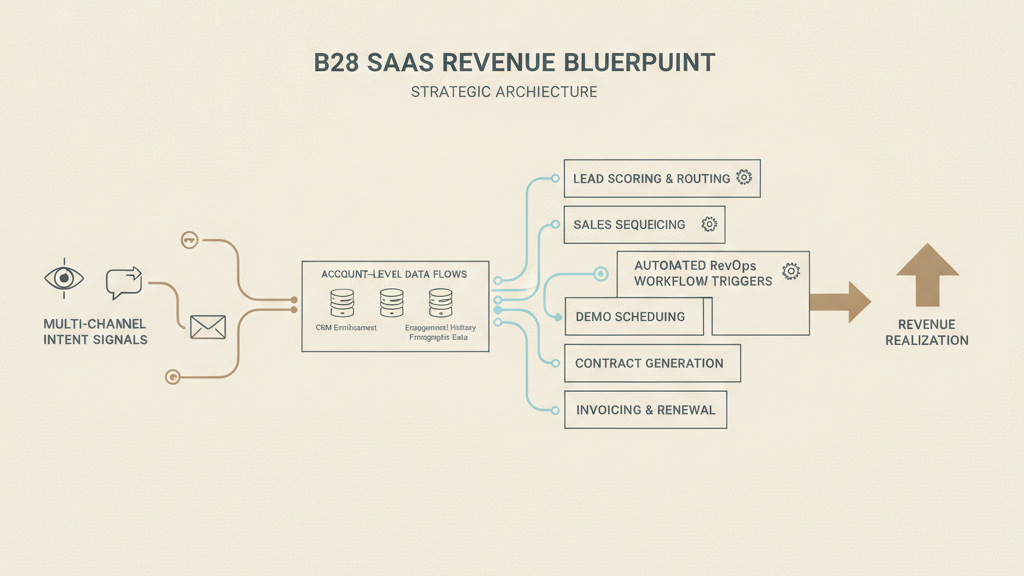
To capitalize on intent signals, top-quartile B2B SaaS organizations are fundamentally re-architecting their GTM tech stacks around a unified Signal Realization Framework. Rather than treating intent data as a secondary enrichment feed for marketing, RevOps leaders are integrating real-time signal realization directly into core sales execution workflows across three primary vectors:
- First-Party Intent Signals: Capturing de-anonymized account traffic on high-intent website pages (pricing, documentation, comparison pages, integration directories) and mapping visit frequency directly to target account profiles in CRM systems.
- Third-Party Intent Surges: Aggregating topic-level intent surges from platforms like 6sense, Demandbase, and N.Rich to identify target accounts actively researching key industry problem sets and competitor solutions across external digital media properties.
- Relationship & Operational Signals: Tracking executive job changes, department headcount expansions, quarterly funding announcements, and technology installation updates using platforms like Clay and HubSpot to time sales outreach with maximum organizational relevance.
Strategic Operational Blueprint for GTM Executives
Transitioning an enterprise SaaS revenue engine from legacy lead scoring to a modern signal-based GTM model requires a disciplined execution strategy across three structural layers:
- Layer 1: Sunset MQL Thresholds in Favor of Account Intent Scores. Discontinue using static point thresholds as the gateway for sales handoffs. Replace MQL reporting with Account Intent Realization (AIR) tiers based on multi-channel signal velocity across the entire buying committee.
- Layer 2: Build Automated Signal Orchestration Workflows. Utilize RevOps automation layers to connect real-time intent triggers directly to SDR task queues and ad platforms. When a target account exhibits an intent surge, automatically trigger contextual ad campaigns to the buying committee and surface personalized sales playbooks to account executives.
- Layer 3: Align Compensation and Metrics around Account Engagement Quality. Shift marketing and SDR incentives from raw lead volume to Account Engagement Score (AES) milestones and pipeline creation within target account tiers. Ensure marketing and sales are measured on shared pipeline velocity and net-new ARR metrics.
The Bottom Line for GTM Leaders
If I had to boil down what this data means for VP of Marketing and GTM leaders preparing for their next fiscal growth cycle, it comes down to three operational imperatives:
- Abandon static lead scoring before it further degrades sales efficiency. Scoring individual clicks in isolation obscures genuine organizational purchase intent. High-performing GTM engines measure account-level intent velocity across all decision-makers rather than chasing isolated form downloads.
- Architect a unified signal orchestration layer across RevOps. Intent data is useless if it sits isolated inside a marketing dashboard. Intent signals must automatically route to sales execution tools, triggering real-time, context-rich outreach at the exact moment buying committees are evaluating solutions.
- Realign GTM teams around shared account-level revenue outcomes. Eliminating the friction between marketing and sales requires replacing legacy MQL targets with unified pipeline velocity and net-new ARR goals tied to verified target account engagement.
In an era where buyers make decisions before your sales team ever hears from them, sustainable GTM authority is not earned by chasing form fills, but by architecting a revenue engine that listens attentively to real buyer signals and responds with undeniable value.
Disclaimer: This article was created with the assistance of Artificial Intelligence tools to support research, structure, and editorial drafting, in full compliance with AI transparency principles and the EU AI Act.
