
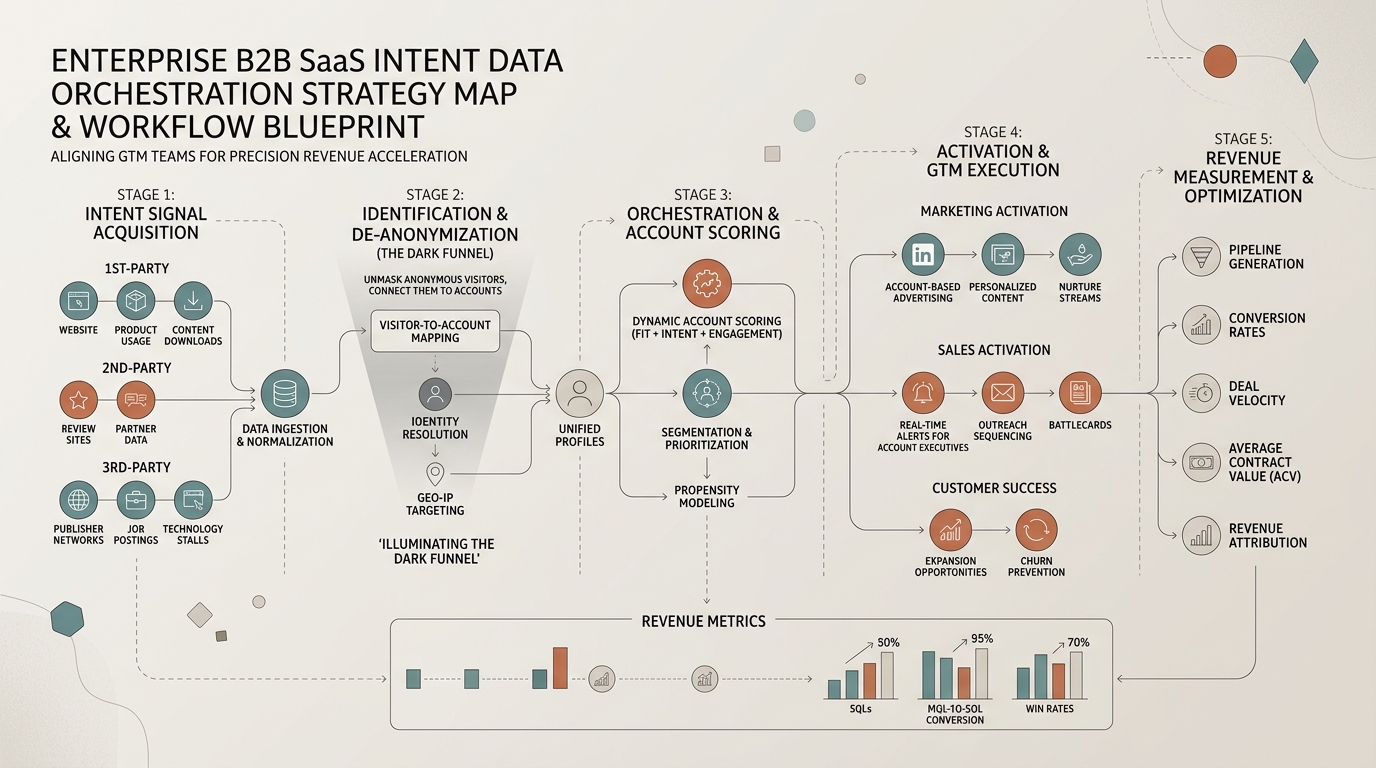
For the past five years, enterprise B2B SaaS Go-To-Market (GTM) playbooks have been dominated by a single, alluring promise: that buying intent could be distilled into automated real-time alerts and purchased directly off third-party marketplace shelves. Marketing and Sales executives invested millions in intent data platforms, IP lookup tables, and automated Account-Based Marketing (ABM) engines. We configured triggers that alerted account executives whenever a target account spiked on broad category keywords or visited third-party review sites. We convinced our executive boards that third-party intent data had effectively solved the opacity of the dark funnel, transforming cold outbound into warm, contextual sales conversations.
But in 2026, as enterprise software sales cycles stretch past nine months and Customer Acquisition Costs (CAC) reach unsustainable highs across mid-market and enterprise SaaS tiers, RevOps leaders are confronting an uncomfortable truth: the vast majority of third-party intent signals are complete digital noise. Millions of dollars in ad spend and thousands of SDR hours are being wasted chasing transient browsing spikes that never materialize into real, qualified pipeline.
The Anomaly of Third-Party Intent Noise
The foundational flaw of traditional ABM intent orchestration lies in its reliance on coarse, unverified aggregate data. Most legacy intent platforms aggregate third-party domain activity by mapping IP addresses to corporate networks and scoring topic surges across content syndication networks. However, modern enterprise working models—characterized by distributed hybrid teams, VPN routing, and co-working networks—have rendered IP-to-company mapping deeply imprecise.
Recent benchmarking from 6sense and Demandbase reveals that up to 74% of third-party intent surges fail to correlate with active buying evaluation. A surge on a term like “enterprise cloud security” or “data pipeline architecture” is just as likely to be triggered by an entry-level developer researching a technical blog, a competitor conducting market analysis, an academic researcher, or an automated scraper as it is by a decision-maker with buying authority.
When revenue teams treat every broad third-party keyword surge as an active buying signal, they commit a fundamental GTM error: confusing passive informational interest with commercial buying intent. The result is SDR burnout, degraded domain reputation from unsolicited outbound sequences, and growing friction between marketing and sales departments.
The Multi-Stakeholder Buying Committee Reality
A second critical structural disconnect in legacy ABM strategies is the failure to account for multi-stakeholder consensus dynamics. Enterprise B2B SaaS purchasing decisions are almost never made by isolated individuals. According to global buyer research from Gartner, the average enterprise software buying committee now comprises 6 to 10 distinct decision-makers—spanning finance, security, IT architecture, end-user operations, and executive leadership.
Gartner’s data reveals that individual buyers spend only 5% of their total evaluation time interacting directly with sales representatives, spending over 83% of their journey conducting independent research across digital channels. In this complex buying environment, a single user from an account reading an article or visiting a third-party review board represents an insignificant fraction of the overall buying committee’s evaluation momentum.
When RevOps teams trigger outbound sales sequences based on isolated, single-person signals, they enter sales conversations prematurely. Outbound reps attempt to pitch solutions before the internal buying committee has reached consensus on problem identification, technical requirements, or budget allocation—causing prospective buyers to retreat into the anonymity of dark social channels.
From Isolated Signals to First-Party Convergent Velocity
High-performing B2B SaaS GTM organizations are abandoning static third-party intent feeds in favor of dynamic, first-party signal orchestration. Comprehensive revenue attribution research from Dreamdata and HockeyStack shows that true enterprise buying intent is characterized not by isolated keyword spikes, but by convergent multi-touch velocity across first-party digital assets.
Across analyzed enterprise software deals spanning 180-day purchase cycles, Dreamdata identified an average of 31 distinct digital touchpoints across 6 separate channels before an account booked a formal product demonstration. Crucially, the accounts that successfully closed as high-ACV enterprise contracts demonstrated a distinct pattern: multiple decision-makers from the same domain engaging concurrently with high-intent first-party content—such as API documentation, interactive pricing calculators, compliance certifications, and product architecture guides.
Furthermore, GTM performance studies from McKinsey & Company and Bessemer Venture Partners demonstrate that SaaS organizations transitioning from third-party ABM feeds to unified first-party signal engines achieved a 32% reduction in CAC payback periods and a 28% increase in win rates. By capturing first-party product-led signals and dark social engagement, RevOps teams can accurately identify the precise window when buying committees transition from problem exploration to active vendor evaluation.
Executive Summary: Navigating the 2026 GTM Shift
If I had to boil down what this data means for VPs of Marketing and Go-To-Market leaders evaluating their 2026 growth strategies, it comes down to three operational imperatives:
- Shift from static third-party intent feeds to unified first-party signal orchestration: De-prioritize broad keyword marketplace alerts and invest in data pipeline infrastructure that captures real-time first-party digital footprints, product-led usage signals, and account-level content depth.
- Align outbound sales triggers with multi-stakeholder committee convergence: Restrain sales outreach until multiple decision-makers within a single target account demonstrate concurrent, high-intent interaction across pricing, security, and integration documentation.
- Re-calibrate GTM performance around account velocity rather than lead volume: Replace superficial vanity metrics—such as lead form submissions and ad impressions—with true north star metrics: multi-stakeholder account engagement depth, pipeline velocity, and CAC payback efficiency.
In the modern B2B SaaS landscape, category leadership is not bought through ad noise or aggressive outbound outreach; it is conferred by self-directed buying committees who choose authority and trust long before your sales team ever hears from them.
Disclaimer: This article was created with the assistance of Artificial Intelligence tools to support research, structure, and editorial drafting, in full compliance with AI transparency principles and the EU AI Act.
