
For more than a decade, Account-Based Marketing (ABM) has been hailed by executive leadership teams as the ultimate antidote to top-of-funnel marketing inefficiency in enterprise B2B SaaS. The strategic pitch was undeniably compelling: instead of casting a wide net with generic demand generation campaigns, revenue teams would define a static target list of 500 or 1,000 high-value accounts, surround their buying committees with programmatic display ads, deploy automated outbound sales sequences, and systematically harvest high-margin pipeline. In an era of cheap venture capital and zero-interest-rate environments, this brute-force account-surround strategy generated enough pipeline to mask underlying structural flaws. But in 2026, as Customer Acquisition Costs (CAC) reach historic highs and buyer resistance hits an all-time peak, GTM leaders face an uncomfortable truth: static ABM is actively stalling enterprise growth engines.
The Structural Flaw of Static Target Account Lists
The fundamental failure of legacy ABM models lies in their reliance on static, calendar-based target account selection. Annual or quarterly account planning sessions traditionally result in sales and marketing agreeing on a locked list of target accounts based solely on static Firmographic and Technographic criteria—such as employee headcounts, annual revenue brackets, or installed technology stacks. However, this approach ignores a crucial reality of modern enterprise buying psychology.
Empirical research from 6sense and Demandbase across thousands of enterprise SaaS organizations reveals that at any given time, only 3% to 5% of your target account universe is actively in an open buying cycle. The remaining 95% of accounts are completely out-of-market, preoccupied with internal restructurings, existing vendor contract locks, or competing operational priorities. When GTM teams freeze their account lists for 6 or 12 months, over 80% of marketing ad spend and SDR outbound capacity is wasted attempting to manufacture demand among accounts that have zero immediate purchase readiness. Meanwhile, high-intent buying signals from unlisted accounts outside the static tier are routinely ignored, allowing active opportunities to fall into competitors’ hands.
The Dark Funnel Paradox and Buying Committee Expansion
While marketing departments burn capital running display ad campaigns against dormant accounts, modern enterprise purchasing decisions are being negotiated entirely out of sight. The romanticized idea of a single VP-level decision-maker evaluating software through official vendor channels is completely obsolete in 2026.
Comprehensive market research conducted by Gartner and Forrester Research indicates that modern B2B SaaS buying committees have expanded to an average of 11 to 14 distinct stakeholders spanning enterprise IT architecture, cybersecurity, legal compliance, procurement, and specialized end-user RevOps teams. More importantly, upwards of 83% of pre-purchase research occurs entirely within the dark funnel—an untrackable network of private executive Slack communities, peer-to-peer referral networks, ungated technical documentation, podcasts, and dark social channels. By the time an enterprise account submits a formal contact request or requests a custom quote, they have completed over 70% of their evaluation, finalized vendor shortlists, and established strict feature requirements without ever engaging with a sales rep.
The Attribution Mirage: Why Legacy MTA Rewards Noise Over Revenue
Why do executive teams continue funding low-ROI display ads and cold outbound sequences despite declining pipeline conversion rates? The answer lies in the misleading feedback loops created by legacy Multi-Touch Attribution (MTA) software.
Traditional software-based MTA tools rely on digital tracking pixels, cookies, and direct web form fills. Consequently, they heavily credit easily trackable channels—such as branded paid search, display ad impressions, and automated sequence email clicks—while completely failing to measure dark social conversations or ungated content consumption. Multi-touch attribution studies from Dreamdata and HockeyStack—analyzing over $1.5 billion in enterprise B2B SaaS pipeline—demonstrate that display ad clicks, gated whitepaper downloads, and automated cold sequence opens account for less than 10% of closed-won ARR influence. Conversely, ungated dark social interactions, repeated anonymous visits to technical API documentation, and executive peer referrals drive 68% of enterprise deal velocity and win-rate expansion.
When revenue leaders allocate GTM budgets based strictly on legacy MTA software, they over-index on easily measurable digital noise while starving the high-trust, ungated channels that actually build authentic category authority.
The Dynamic Signal Orchestration Architecture
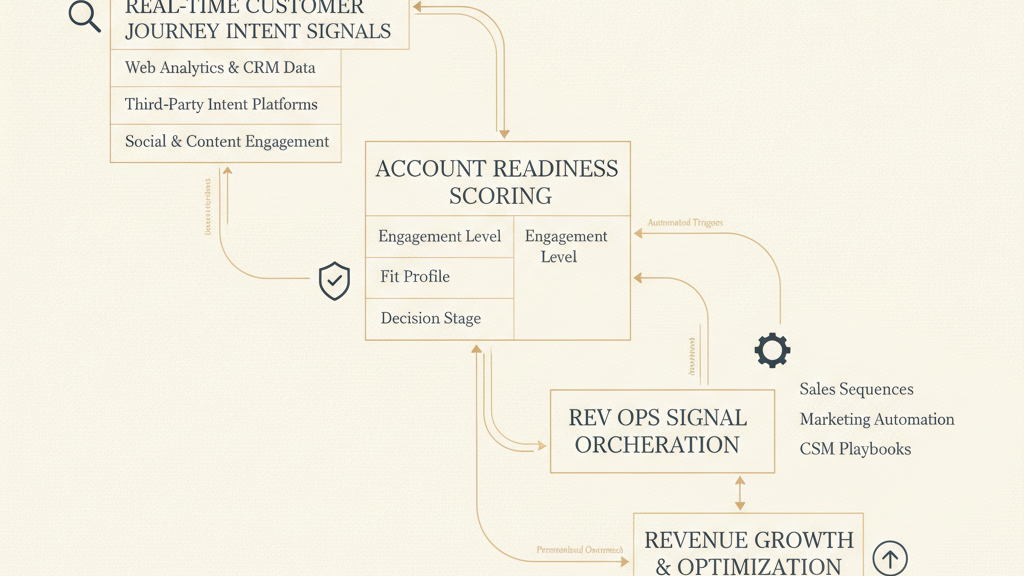
To break free from rising CAC payback periods and stagnant sales velocity, top-quartile Revenue Operations and GTM executives are transitioning from static ABM lists to dynamic, signal-led revenue orchestration. Benchmark studies from Bessemer Venture Partners and OpenView SaaS Benchmarks reveal that top-performing B2B SaaS companies—those maintaining Net Retention Rates (NRR) above 115% and CAC payback under 12 months—allocate over 50% of their GTM capital toward ungated dark social distribution and first-party signal orchestration. As a result, these market-leading organizations achieve 3.5-month faster CAC payback periods and 29% higher win rates against entrenched enterprise competitors.
Transitioning from static target account lists to a dynamic signal orchestration model requires executing three fundamental operational shifts:
- Shift 1: Real-Time Intent Signal Aggregation. Replace static annual account lists with dynamic data orchestration layers like Clay and Factors.ai. Continuously ingest first-party website engagement, technical documentation visits, job change alerts, executive key hires, and third-party intent data to dynamically score and route accounts the exact moment active intent velocity spikes.
- Shift 2: Frictionless Dark Social Distribution. Remove gates from technical architecture guides, API documentation, and pricing calculators. Distribute high-value tactical insights directly into executive channels and social platforms without forcing buyers to submit an email address. Building deep category trust among out-of-market accounts ensures your brand is the default choice when active buying cycles initiate.
- Shift 3: Contextual, Signal-Driven Sales Execution. Reorient SDRs and Account Executives from rigid automated sequence blasting to signal-driven outreach. Equip sales reps with granular intent context—such as multiple members of an account evaluating integration documentation or security compliance pages—enabling reps to engage with tailored, consultative insights at the precise moment of active buying evaluation.
Executive Takeaway: Building Sustainable Revenue Velocity
If I had to boil down what this data means for VPs of Marketing and Revenue Leaders looking at their GTM strategies, it comes down to three operational imperatives:
- Replace static target account lists with dynamic intent signal orchestration: Pivot GTM budgets from fixed account tiers to real-time account readiness scoring to eliminate ad waste and outbound fatigue.
- Un-gate core technical assets to maximize dark funnel mindshare: Provide enterprise buying committees with frictionless access to pricing, integration blueprints, and product documentation where they research in silence.
- Align sales outreach strictly with active intent velocity thresholds: Empower revenue teams with real-time intent interaction data so sales engagement feels consultative and timely rather than intrusive.
In the modern enterprise B2B SaaS landscape, sustainable revenue momentum is not achieved by forcing buyers into rigid sales sequences, but by building unquestioned category authority long before they ever reach out.
Disclaimer: This article was created with the assistance of Artificial Intelligence tools to support research, structure, and editorial drafting, in full compliance with AI transparency principles and the EU AI Act.

Comments