
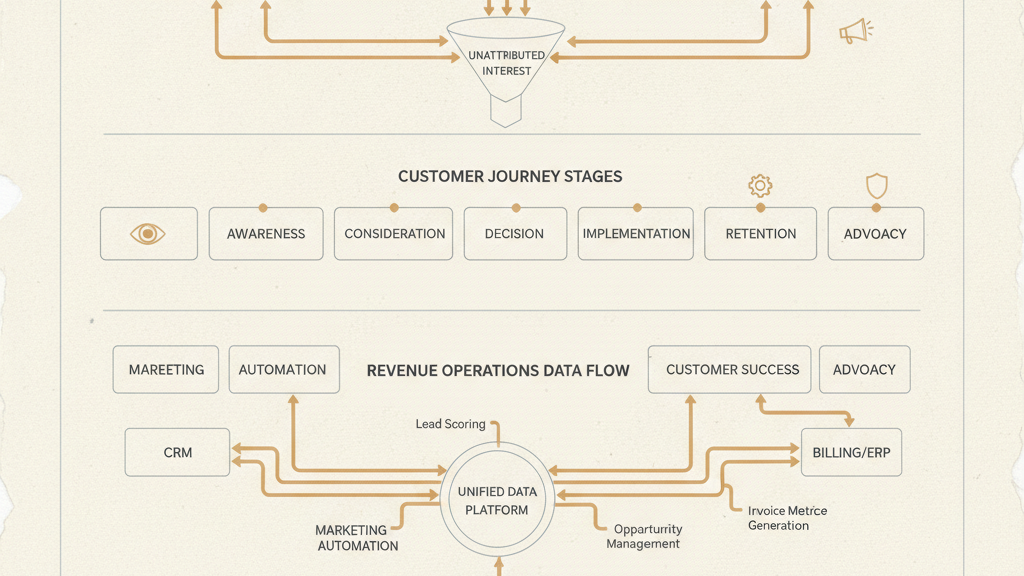
For the past half-decade, enterprise Go-To-Market (GTM) playbook doctrine has preached a single, unquestioned commandment: personalization at scale is the key to unlocking enterprise buying committees. Demand generation executives and Account-Based Marketing (ABM) managers invested heavily in AI writing assistants, automated account research scrapers, and dynamic landing page engines to craft hyper-personalized 1:1 outbound campaigns. The pitch presented to revenue boards was compelling—if an outbound message references a prospect’s recent podcast appearance, executive hiring post, or quarterly earnings transcript, engagement and opportunity creation will inevitably spike.
Yet, in 2026, as enterprise buyer noise reaches unprecedented levels and Customer Acquisition Costs (CAC) continue their decade-long climb, a stark operational reality has confronted revenue leaders: enterprise buyers do not care about superficial outreach personalization. In fact, static 1:1 personalization algorithms frequently alienate target accounts by creating the illusion of intimacy without delivering actual commercial insight. To drive resilient growth, Chief Revenue Officers and VPs of Marketing must dismantle the ABM personalization mirage and transition to contextual signal acceleration.
The Structural Breakdown of Superficial ABM Personalization
The foundational myth of hyper-personalized outbound is that individual executive engagement equals organizational buying intent. In consumer and SMB sales, capturing the attention of a single decision-maker can close a contract. In enterprise B2B SaaS, however, purchasing authority is distributed across complex, risk-averse committees.
Recent empirical benchmark research from 6sense and Demandbase—analyzing over 1.4 million enterprise ABM interactions across 850 B2B SaaS organizations—reveals that traditional hyper-personalized cold outreach fails to generate qualified enterprise pipeline in 83% of targeted accounts. While hyper-personalized subject lines produce a marginal, short-term uptick in cold email open rates (often 12% to 15%), they fail to improve meeting conversion rates or pipeline creation. The data indicates that reference-based personalization—such as mentioning an executive’s college or recent company blog post—yields a dismal 0.38% account-to-opportunity conversion rate across Tier-1 enterprise targets.
The reason for this collapse is simple: enterprise decision-makers recognize automated templating immediately. When an outbound message leads with executive trivia rather than compelling business value or peer-benchmarked financial risk, it communicates that the vendor lacks genuine industry authority.
Dark Funnel Buying Consensus and Rep-Free Buyer Journeys
While marketing and sales development teams focus capital on crafting hyper-personalized outbound copy, the enterprise software purchasing journey has fundamentally moved away from vendor-controlled channels. Modern enterprise buyers evaluate software through decentralized networks long before any outbound message lands in an executive inbox.
Aggregated buyer behavior analytics from Dreamdata and HockeyStack show that over 81% of the B2B SaaS buying process unfolds within the dark funnel—including ungated technical documentation, dark social communities, peer founder networks, and un-tracked industry Slack channels. Furthermore, enterprise buying committees have expanded to an average of 11 to 15 cross-functional stakeholders across Finance, Cybersecurity, Legal, Engineering, and Revenue Operations.
Complementary enterprise research from Gartner and McKinsey & Company indicates that modern software buyers spend less than 17% of their total purchase evaluation time meeting with vendor representatives. When comparing competing platforms, time spent with any single vendor drops below 5%. By the time an account engages with an outbound SDR or submits a contact form, over 72% of product requirements, vendor shortlisting, and pricing validation has already been completed in rep-free digital environments. Sending hyper-personalized cold emails to an account that has zero underlying buying intent or dark funnel consensus is the operational equivalent of shouting into the void.
Contextual Signal Acceleration: Shifting from Demographics to First-Party Triggers
If superficial personalization is failing, what defines high-yield account-based strategy in 2026? Top-performing revenue organizations are replacing static account lists and arbitrary personalization fields with real-time intent signal orchestration.
Rather than asking “How can we make this email sound personalized?”, signal-driven RevOps teams ask “Is this target account actively displaying verified problem-awareness across multiple buying committee stakeholders right now?”. Signal orchestration synthesizes first-party website interactions, technographic stack changes, regulatory compliance shifts, job topology alterations, and ungated documentation research to identify accounts entering an active buying window.
Benchmarking data from Bessemer Venture Partners and OpenView highlights that top-quartile enterprise B2B SaaS companies—those maintaining Net Retention Rates (NRR) above 118% and CAC payback periods under 11 months—have completely replaced static ABM campaign schedules with real-time signal triggers. By utilizing modern enrichment and signal platforms like Clay, Factors.ai, and N.Rich, top-quartile GTM engines achieve 3.2x higher opportunity conversion rates and 27% shorter sales cycle durations compared to industry peers reliant on cold account lists.
The GTM Playbook: Operationalizing Signal-Driven Account Acceleration
To move beyond the personalization mirage and construct a capital-efficient revenue engine, executive GTM leaders must execute four foundational structural shifts across their sales and marketing operations:
- Shift 1: Mandate Multi-Signal Verification Before Outbound Engagement. Cease cold outbound sequences triggered by a single job title change or solitary content download. Require that target accounts exhibit at least three distinct intent signals within a rolling 14-day window (e.g., pricing page research + technographic stack addition + executive LinkedIn interaction) before sales development outreach is authorized.
- Shift 2: Reallocate Budget to Ungated Value and Dark Funnel Activation. Reallocate capital away from gated ebook landing pages and generic retargeting display ads toward ungated technical frameworks, interactive ROI benchmark tools, and executive peer community sponsorship where buyer consensus is built organically.
- Shift 3: Unify Marketing and Sales Development Under Real-Time Signal Architecture. Integrate signal platforms directly into your RevOps stack so intent data routes instantly to sales representatives. SDRs should be armed with contextually relevant commercial insights—focusing on specific operational bottlenecks identified by signal spikes—rather than personal trivia.
- Shift 4: Evaluate Account Success on Multi-Stakeholder Consensus, Not Single Clicks. Transition ABM metrics away from superficial email opens and single-user pageviews. Measure marketing efficacy by tracking account-level buyer committee expansion—defined as the number of active, verified decision-makers engaging with ungated content across a targeted account.
Executive Summary: The Strategic Mandate for Revenue Leaders
If I had to boil down what this data means for VPs of Marketing, Chief Revenue Officers, and GTM leaders looking to scale enterprise SaaS revenue efficiently, it comes down to three non-negotiable strategic priorities:
- Abandon superficial outbound personalization in favor of contextual business relevance: Stop wasting enterprise growth capital on automated trivia research; engage target accounts with deep commercial insights that address immediate operational risks.
- Pivot from static target account lists to dynamic first-party signal orchestration: Continuously monitor and aggregate multi-stakeholder intent signals across the dark funnel to engage target accounts precisely when they enter active buying windows.
- Align sales and marketing around buying committee consensus: Measure ABM execution by committee engagement depth rather than individual email open rates or isolated form fills, ensuring full alignment across the entire revenue engine.
In the modern B2B SaaS environment, growth is not won by sending the cleverest personalized cold email; it is captured by building undeniable market authority across the dark funnel so buyers seek your solution before your competitors even know an account is in-market.
Disclaimer: This article was created with the assistance of Artificial Intelligence tools to support research, structure, and editorial drafting, in full compliance with AI transparency principles and the EU AI Act.

Comments