
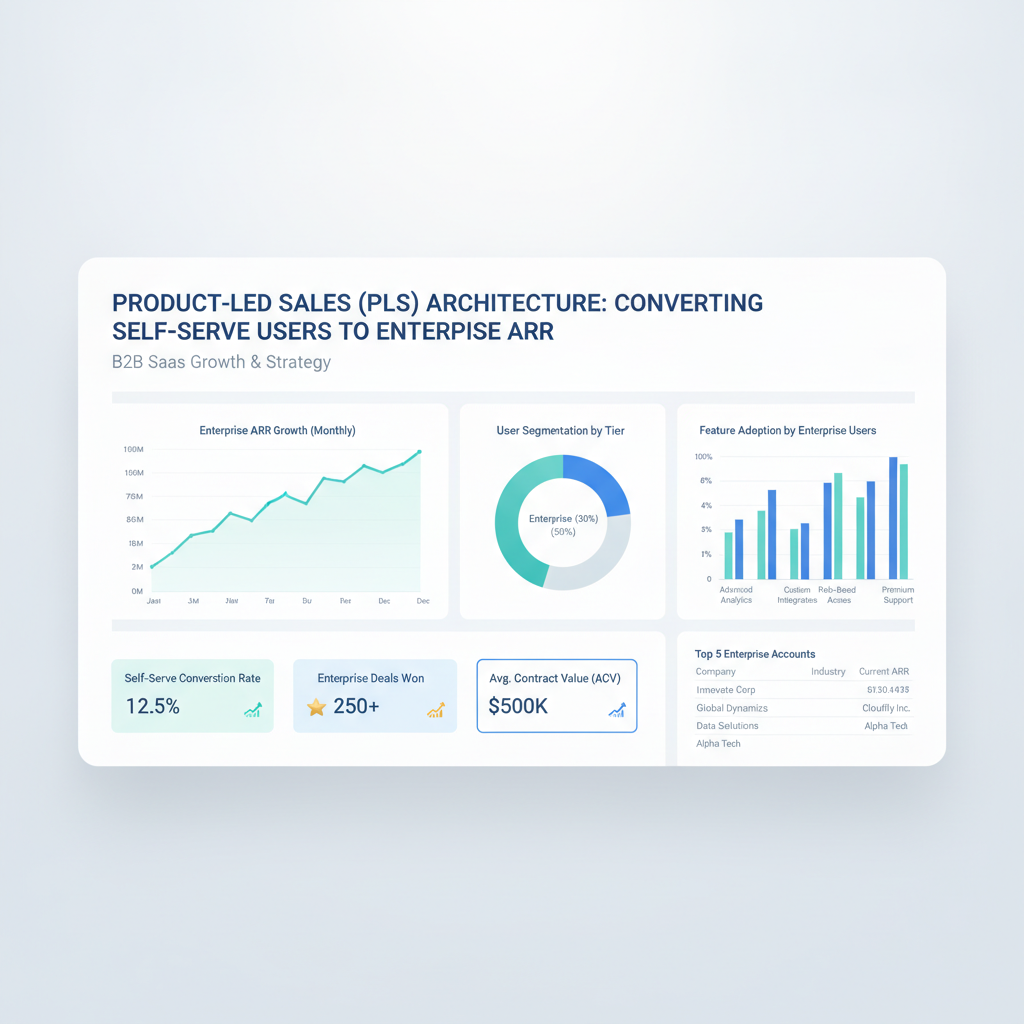
Product-Led Sales (PLS) Architecture: Converting Self-Serve Users to Enterprise ARR
Pure-play Product-Led Growth (PLG) hits a revenue ceiling. While self-serve models excel at low-friction developer adoption and rapid user acquisition, credit-card checkouts rarely scale to six-figure enterprise contracts without direct sales intervention. Complex organizations require procurement clearance, custom security reviews, specialized SLAs, and executive alignment—hurdles that self-serve checkout flows can’t clear on their own.
The solution isn’t choosing between PLG and traditional outbound sales. It’s deploying a hybrid Product-Led Sales (PLS) architecture that converts organic product usage into enterprise ARR expansion.
Hybrid PLS conversion pipeline
1. Self-Serve Signup
Low-friction adoption and initial workspace creation.
2. Usage Telemetry
Product signals sync into the data warehouse and orchestration layer.
3. Product Qualified Account
Multi-user and paywall signals validate institutional buying potential.
4. AE Expansion
Account executives open a direct enterprise expansion motion.
1. Defining the Product Qualified Account (PQA) Engine
Routing individual free-tier signups to account executives wastes bandwidth. Enterprise reps shouldn’t chase individual users; they intervene when multi-user consolidation signals institutional scale.
| PQA Indicator Category | Telemetry Signal | Operational Sales Action |
|---|---|---|
| Domain Velocity | More than 8 signups from the same corporate domain in 7 days | Automated SDR outreach to the IT or Engineering lead offering workspace consolidation |
| Paywall Friction | Workspace hits SSO or audit-logging thresholds twice in 24 hours | AE outreach highlighting enterprise compliance, governance, and custom SLAs |
| Executive Adoption | User with VP or C-level title added to an active workspace | Executive-to-executive engagement initiated by founder or VP of Sales |
2. Tech Stack Requirements for PLS Orchestration
Connecting product usage data to sales workflows requires dedicated operational infrastructure. Middleware platforms like Correlated or Pocus pull real-time usage metrics from cloud data warehouses such as Snowflake and BigQuery and translate them directly into CRM objects inside Salesforce or HubSpot.
PLS orchestration flow
- Product telemetry warehouse: usage events and account-level thresholds are captured in Snowflake or BigQuery.
- PLS engine: Correlated or Pocus evaluates signals and maps them to account records.
- AE alerting: the assigned rep receives a Slack alert with seat usage, team distribution, and paywall triggers.
When an account crosses a predefined PQA threshold, the assigned AE receives an alert enriched with workspace usage history, team distribution, and specific paywall triggers. This equips the rep to open a consultative, context-rich conversation grounded in real-world platform usage rather than cold sales claims.
3. Resolving Channel and Compensation Conflict
Channel conflict ruins hybrid PLG models faster than poor tech stack integration. If enterprise account executives aren’t compensated for self-serve conversions within their assigned territories, they will push buyers away from self-serve onboarding toward traditional, high-friction sales calls.
Align incentives across channels by adopting a unified territory compensation model. Pay enterprise reps full commission on all ARR expansion generated within their assigned accounts—regardless of whether the deal originated through a self-serve credit card checkout or a sales-negotiated contract.
4. Key Execution Metric: PQA-to-Pipeline Conversion Rate
Track the velocity and efficiency of your PLS pipeline by measuring the conversion rate from validated PQA to closed-won enterprise deal:
PQA Conversion Rate % = (Closed-Won Enterprise Deals from PQAs / Total Qualified PQAs Routed to Sales) × 100
A healthy hybrid PLS engine yields 2.5x to 3x higher win rates compared to cold outbound pipelines because product adoption, user reliance, and internal utility are already validated before the sales team initiates formal contract negotiations.
Disclaimer: ai sensi dell’EU AI Act, this article was written with support from AI.
