
Demand Capture Is Quietly Eating Your Demand Creation Budget, and Nobody’s Tracking It
By Gaetano Romeo, Head of Global Digital Marketing, EasyVista
Every B2B SaaS marketing team I talk to says they believe in the balance between demand creation and demand capture. Almost none of them can tell me, without checking a spreadsheet, what their actual split is. That gap between stated belief and measured reality is where most B2B pipeline problems quietly originate.
The 95:5 Rule Nobody Actually Budgets Around
The foundational number here comes from the LinkedIn B2B Institute: at any given moment, only about 5% of your addressable market is actively in a buying cycle. The other 95% aren’t looking for a solution like yours right now, and won’t be for another nine to eighteen months depending on the category.
Ask any B2B SaaS marketing leader if they know this stat, and almost everyone will say yes. Ask them what percentage of their budget goes toward that 95% versus the 5%, and the answer usually gets vague. That vagueness isn’t an accident. It’s the direct result of how these two activities get measured.
Why Demand Capture Always Wins the Budget Fight, Even When Nobody Decides It Should
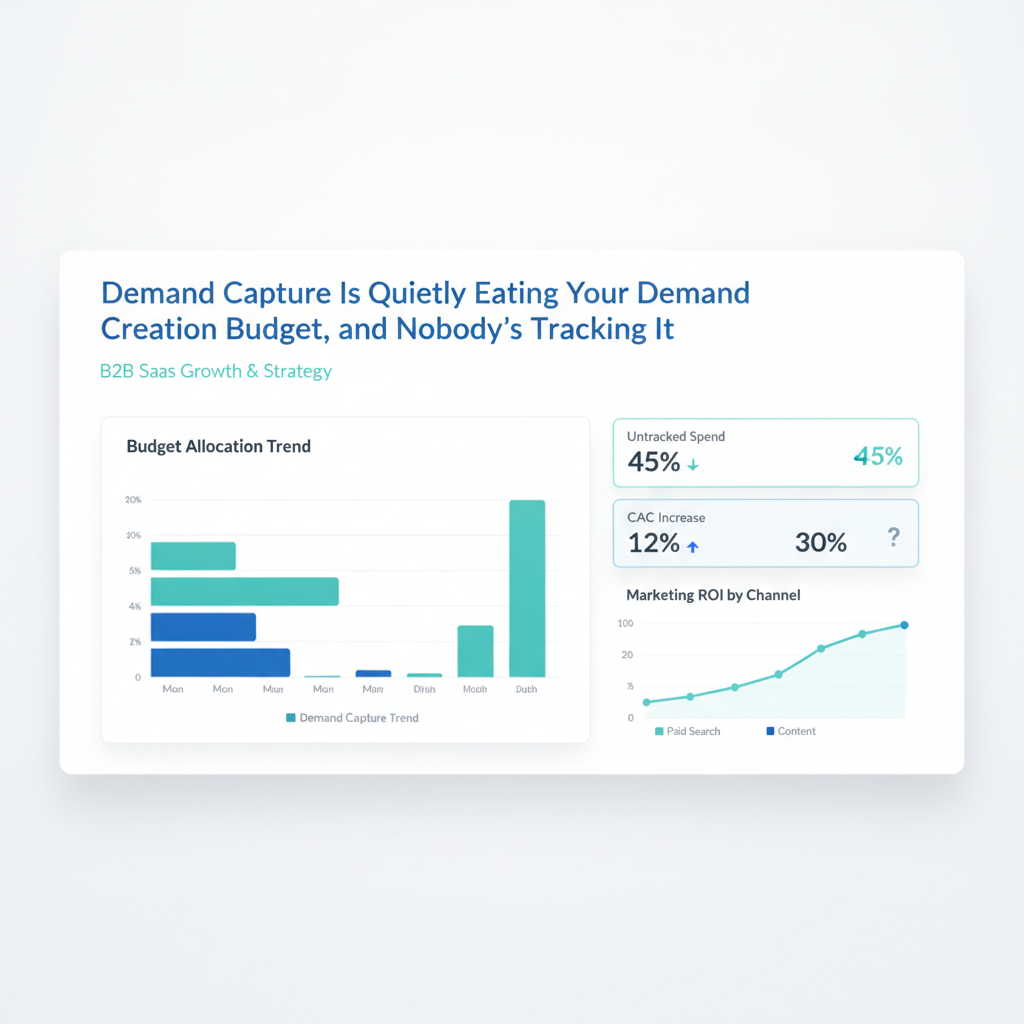
A recent analysis of B2B marketing budgets found that most companies spend somewhere between 70% and 80% of budget on demand capture activities, paid ads, direct outreach, conversion optimization, while allocating only 20% to 30% to demand creation, content, SEO, brand building. That’s roughly the inverse of what research on high-growth B2B companies actually recommends: a 60-70% allocation toward demand creation and 30-40% toward capture.
The mechanism behind this gap isn’t strategic disagreement, it’s measurement bias. Demand capture activities produce clean, fast, attributable numbers. A paid search campaign shows a cost per lead within days. A LinkedIn form fill shows up in the CRM the same afternoon. Demand creation activities, content, thought leadership, brand-building social, produce influence that shows up months later, diffused across a buying committee, almost impossible to tie to a single campaign in a quarterly report.
When a CMO has to defend a budget line in a Monday leadership meeting, the channel with the same-day dashboard wins the argument every time, regardless of what it’s actually building for the business long-term. That’s not a strategy decision. It’s a reporting artifact quietly making strategy decisions for you.
The Advertising Research Backs This Up Beyond B2B
This isn’t a B2B-only phenomenon. The classic Binet and Field research on brand versus activation spend, now widely cited across categories, suggests the optimal split for most brands sits around 60% brand building and 40% sales activation. In B2B specifically, that brand-building share arguably deserves to be even more protected, because the brand functions as a risk reducer and quality signal precisely at the moment when 95% of the market isn’t actively evaluating anyone, and a decision maker’s only exposure to you is whatever mental availability you built months or years earlier.
Companies pulling budget out of broad-reach demand generation and into more measurable channels like ABM are seeing real results too, ABM-led programs reportedly generate 2.6x more pipeline per marketing dollar than broad-reach demand gen. But that’s a case for smarter capture, not a case for starving creation. ABM still depends on a market that already has some baseline awareness and trust to convert efficiently. Without demand creation building that awareness among the 95%, ABM just becomes a more efficient way to fight over the same shrinking 5%.
What Happens When You Only Feed the 5%
If you only invest in demand capture, you’re not really growing your addressable pipeline, you’re competing more intensely for a fixed pool of already in-market buyers, alongside every competitor doing the exact same thing. The predictable result: rising acquisition costs, declining conversion rates over time, and a pipeline number that becomes more volatile, not less, because it’s entirely dependent on how many people happen to be actively shopping this particular quarter.
The moment you pause demand capture spend, the pipeline dries up almost immediately, because there’s no reservoir of built-up awareness and trust to draw from. That’s the tell that a program has drifted too far toward capture. If your pipeline can’t survive a month of reduced ad spend, you haven’t been building demand. You’ve been renting it.
A Framework for Actually Auditing Your Split
A few practical steps that go beyond just knowing the 95:5 rule exists:
- Tag every budget line explicitly as creation or capture before the quarter starts, not after, so the split is a decision rather than an accidental byproduct of which channels happened to get funded.
- Give demand creation activities a longer, explicitly different measurement window. Judging a thought leadership program against the same 30-day attribution standard as a paid search campaign guarantees it will always look like it’s underperforming.
- Track pipeline velocity and win rate for accounts touched by demand creation content months before entering a deal, not just last-touch or first-touch credit, since neither reflects how the 95% actually gets converted into the 5% over time.
- Protect a minimum creation floor, something close to the 60% level the high-growth benchmark suggests, and treat any quarter that drops meaningfully below it as a flag, not a routine reallocation.
The Uncomfortable Bottom Line
Most B2B SaaS marketing teams aren’t failing to understand demand creation versus capture as a concept. They understand it perfectly well in a slide deck. What they’re failing to do is protect the budget split that concept requires, because the measurement systems around them reward the channel that reports well this week over the channel that builds the pipeline nine months from now.
If you’ve never actually tagged and totaled your own creation versus capture split for the current quarter, that’s the audit worth running before your next planning cycle, not after.
[🤖 Co-created with the assistance of AI / Written in alignment with EU AI Act transparency guidelines]
