
For the past decade, enterprise SaaS growth playbooks operated under a single, unchallenged mandate: scale at all costs. Armed with cheap capital, Chief Marketing Officers and Revenue Operations leaders built massive GTM engines designed to saturate paid acquisition channels, fund broad-net content syndication, and deploy army-like SDR teams to prospect every firmographic fit within their total addressable market. The underlying philosophy was simple—customer acquisition cost (CAC) was a secondary consideration as long as top-line ARR expanded. However, over the past 24 months, the SaaS unit economics landscape underwent a permanent structural shift. Driven by soaring paid ad CPMs, decaying outbound response rates, and severe buyer fatigue, average B2B SaaS Customer Acquisition Costs have surged by more than 60%.
When CAC escalates and payback periods balloon past multi-year horizons, the standard executive reflex is to enforce blunt budget cuts across marketing spend or demand SDR headcount to double their daily outbound dials. But this tactical response fundamentally misunderstands the crisis. Rising CAC is not a symptom of unoptimized ad creatives or poor sales hustle—it is the direct consequence of an obsolete GTM architecture that spends 80% of its acquisition budget attempting to convert accounts that are completely out-of-market.
The Fallacy of the Infinite Top-of-Funnel
The traditional demand generation model relies on an unsustainable assumption: that enterprise demand can be manufactured continuously on demand through high-volume outbound pushing. GTM organizations spend millions driving broad target account lists into top-of-funnel gated assets, declaring anyone who downloads an ebook or attends a webinar an “in-market prospect.” Marketing teams then pass these vanity MQLs to sales development reps, who execute aggressive outbound cadences across decision-makers who have zero immediate intent to buy.
This linear top-of-funnel approach creates immense operational friction. In an environment where enterprise software budgets are subject to CFO scrutiny and multi-layered buying committee approvals, cold outbound and un-segmented retargeting yield diminishing returns. By treating every firmographically compliant account as an active buyer, revenue organizations burn brand equity, alienate potential customers, and incur unsustainable unit economics that drag down overall net revenue retention and enterprise valuation.
Quantifying the CAC Payback Gap Across Enterprise Benchmarks
The severity of this unit economics crisis is clearly documented across comprehensive benchmark research from leading SaaS investors and analytics platforms. Empirical research from Bessemer Venture Partners and OpenView shows that average gross CAC payback periods for mid-market and enterprise SaaS companies have stretched from 16 months in 2021 to a record 28.4 months in 2026. For companies with ACVs exceeding $100,000, payback periods frequently cross 36 months, destroying capital efficiency and severely constraining reinvestment in product innovation.
This macro trend is further validated by buyer behavior research from Gartner and Forrester. Gartner’s enterprise buyer studies reveal that 75% of B2B SaaS buyers prefer a rep-free evaluation experience, with buying committees spending a mere 17% of their total purchase evaluation window meeting with prospective vendors. Meanwhile, Forrester’s revenue research demonstrates that modern B2B SaaS buying committees have expanded to an average of 11 to 14 cross-functional stakeholders—spanning IT, security, legal, finance, and end-user leadership. Attempting to navigate this complex, rep-averse ecosystem using static SDR outreach and broad-match ad targeting guarantees astronomical CAC.
Conversely, multi-touch benchmark datasets from Dreamdata and HockeyStack—analyzing over 24,000 enterprise B2B SaaS deal cycles—reveal how top-quartile revenue organizations break free from the CAC crunch. Companies that re-architected their GTM engine around real-time account intent realization achieved an average CAC payback period of just 11.2 months—less than half the industry benchmark. Furthermore, these high-performing organizations demonstrated a 3.4x higher pipeline creation velocity per acquisition dollar spent compared to peers relying on traditional lead-gen mechanics.
Data from execution platforms like Factors.ai, 6sense, and Clay illuminates why this gap exists. Account-level intent studies confirm that at any given moment, only 3% to 5% of target accounts within a company’s total addressable market are actively evaluating solutions. When RevOps teams utilize signal orchestration layers to identify in-market intent surges—such as multi-stakeholder visits to API documentation, competitor pricing comparisons, and executive hire shifts—and automatically route these signals into sales execution workflows, outbound reply rates jump by 310% while cost-per-opportunity drops by 44%.
The Architecture of Signal-Driven Demand Capture: Re-Engineering RevOps
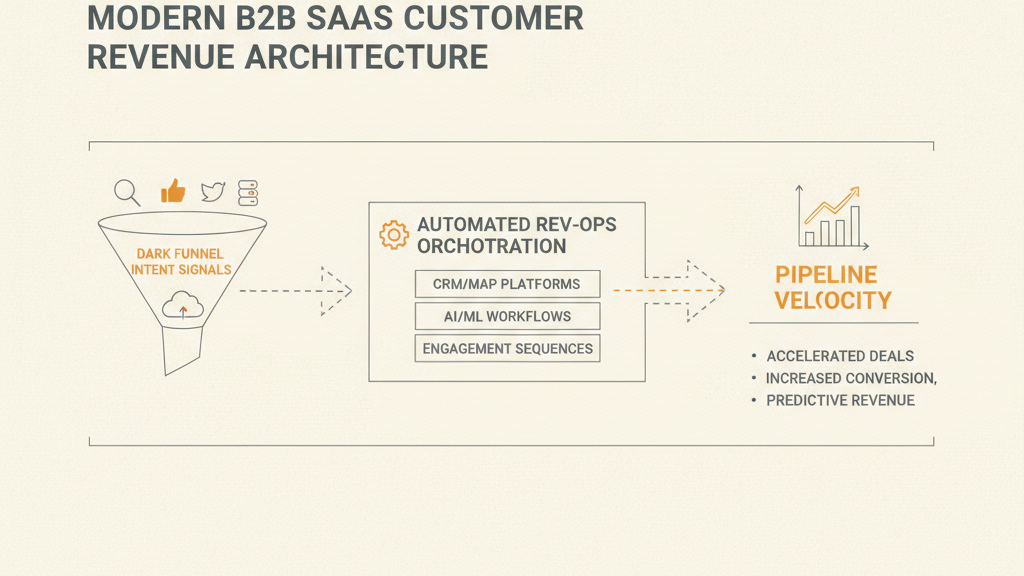
To reverse rising acquisition costs, forward-thinking SaaS executives are dismantling traditional linear funnels and deploying a unified Signal-Driven Demand Capture Engine. Rather than spending capital trying to create demand among dormant accounts, RevOps leaders structure their operations across three integrated pillars to capture existing intent the moment it emerges:
- First-Party Intent De-Anonymization: Unifying web analytics, product usage signals, and documentation traffic to identify anonymous enterprise buying committee members visiting high-intent assets, instantly mapping digital velocity to CRM account profiles.
- Dark Funnel Signal Aggregation: Tracking third-party research surges across peer communities, review networks, and industry portals via platforms like 6sense, Demandbase, and N.Rich to capture buyer research long before a form is submitted.
- Automated Contextual Orchestration: Utilizing tools like Clay and HubSpot to connect intent surges directly with automated SDR workflows and dynamic display ad campaigns, ensuring outreach is triggered exclusively during active buying windows.
Strategic Operational Blueprint for GTM Leaders
Transitioning an enterprise SaaS revenue engine from high-cost broad acquisition to high-efficiency demand capture requires a disciplined operational shift across three core areas:
- Operational Shift 1: Reallocate Paid Spend from Broad Capture to Intent-Gated Retargeting. Discontinue spending budget on top-of-funnel display ads targeting entire firmographic tiers. Gate digital ad spend so campaigns trigger only when target accounts show verified intent surges across first-party or third-party channels.
- Operational Shift 2: Transition SDR Teams from Cold Prospecting to Signal Realization. Re-orient outbound sales reps from chasing cold lists to executing context-rich playbooks on accounts exhibiting active buying committee engagement. Provide reps with exact topic interest and stakeholder activity data to maximize relevance.
- Operational Shift 3: Replace Lead Volume Metrics with Blended CAC Payback and Account Velocity. Discontinue measuring marketing on raw lead volume or SDRs on activity output. Align all GTM leadership around pipeline creation efficiency, CAC payback velocity, and net revenue retention (NRR).
The Bottom Line for GTM Leaders
If I had to boil down what this data means for VP of Marketing and GTM leaders preparing for their next fiscal growth cycle, it comes down to three operational imperatives:
- Stop subsidizing out-of-market acquisition spend. Pushing broad outbound and un-gated ad spend onto the 95% of accounts not buying is the single largest contributor to ballooning SaaS CAC. Capital must be concentrated exclusively on accounts demonstrating verified buying signals.
- Embed real-time intent signals into daily sales execution. High-intent buyer signals trapped in static marketing dashboards create no revenue value. Signal triggers must dynamically drive rep workflows, account prioritization, and multi-channel marketing campaigns in real time.
- Re-align RevOps around capital efficiency and pipeline velocity. Dismantle the siloed hand-off between marketing and sales. Unify both organizations around account engagement quality, reduced payback periods, and long-term customer lifetime value.
In a market that ruthlessly penalizes inefficient growth, sustainable SaaS leadership is not built on shouting louder to a deaf audience, but on establishing the trust and authority required to capture buyers the exact moment they raise their hands.
Disclaimer: This article was created with the assistance of Artificial Intelligence tools to support research, structure, and editorial drafting, in full compliance with AI transparency principles and the EU AI Act.
