
For more than a decade, enterprise B2B SaaS growth playbooks have operated under a foundational dogma: point-based lead scoring is the gold standard of pipeline qualification. Marketing and Revenue Operations leaders invested millions building complex scoring rules within HubSpot, Marketo, and Salesforce, systematically assigning arbitrary numerical values to digital interactions. Download an ebook? Add 10 points. Visit the pricing page twice? Add 15 points. Attend a webinar? Add 20 points. Once an individual contact reached the magical threshold—typically 50 or 75 points—they were officially crowned a Marketing Qualified Lead (MQL) and routed to Sales Development Representatives (SDRs) for immediate aggressive outbound cadence.
It was an elegant, orderly operational construct designed for an era when buying journeys were linear, centralized, and vendor-guided. But in 2026, as software procurement cycles stretch past nine months and enterprise Customer Acquisition Costs (CAC) reach historic highs, GTM executives are facing a sobering operational reality: point-based lead scoring is not accelerating pipeline—it is actively sabotaging capital efficiency.
The Structural Disconnect of Point-Based Qualification
The core vulnerability of legacy lead scoring lies in its reliance on individual activity metrics as proxies for account purchasing intent. Point-scoring architectures treat digital actions in isolation, assuming that higher contact engagement directly correlates with buying readiness. In practice, this assumption creates massive operational distortion across Revenue Operations.
Rigorous SaaS attribution and pipeline velocity research from Factors.ai and Dreamdata—analyzing over $1.8 billion in anonymized enterprise pipeline across 1,200 B2B software vendors—completely dismantles the traditional lead scoring model. The data reveals that 84% of individual contacts flagged as ‘MQLs’ through traditional point-scoring never progress to a Stage-2 qualified pipeline opportunity. In the vast majority of cases, point threshold spikes are driven by junior researchers, students, or job seekers seeking template downloads—individuals with zero budget authority or purchasing influence.
Even more damning, the same research demonstrates that 73% of closed-won ARR originates from accounts that never triggered a single point-scoring milestone or form submission prior to their initial sales discovery call. By anchoring GTM capital and SDR bandwidth to static point thresholds, marketing teams systematically starve active buying committees while chasing ghost leads.
The Invisible Committee and the 79% Out-of-Market Reality
Why has point-based scoring failed so comprehensively? Because modern B2B SaaS acquisition is no longer an individual endeavor; it is an asynchronous, multi-threaded committee evaluation conducted largely in dark channels.
Enterprise buyer behavior benchmark studies from 6sense and Demandbase show that modern enterprise software acquisitions now involve an average of 11 to 15 distinct decision-makers across IT security, architecture, legal, finance, and operational user groups. Furthermore, at any given moment, 79% of accounts on static target account lists are entirely out-of-market, focused on internal operational realignments or budget consolidation. When an out-of-market account accidentally triggers a lead score threshold, forcing an SDR to deploy aggressive phone and email cadences does not create demand—it damages brand reputation and triggers domain unsubscribes.
According to deep buyer journey research from Forrester and McKinley GTM Advisory, upwards of 83% of pre-purchase evaluation occurs within dark social, private peer Slack communities, ungated technical documentation, and un-tracked comparison benchmarks. By the time a buying committee formally reaches out to a vendor, 70% of vendor evaluation and pricing anchoring is already complete. Legacy lead scoring attempts to measure the visible 17% of the buyer journey using flawed point tallies, remaining completely blind to the 83% where purchasing decisions actually take shape.
The Financial Impact: Signal-Led vs. Point-Scored Growth
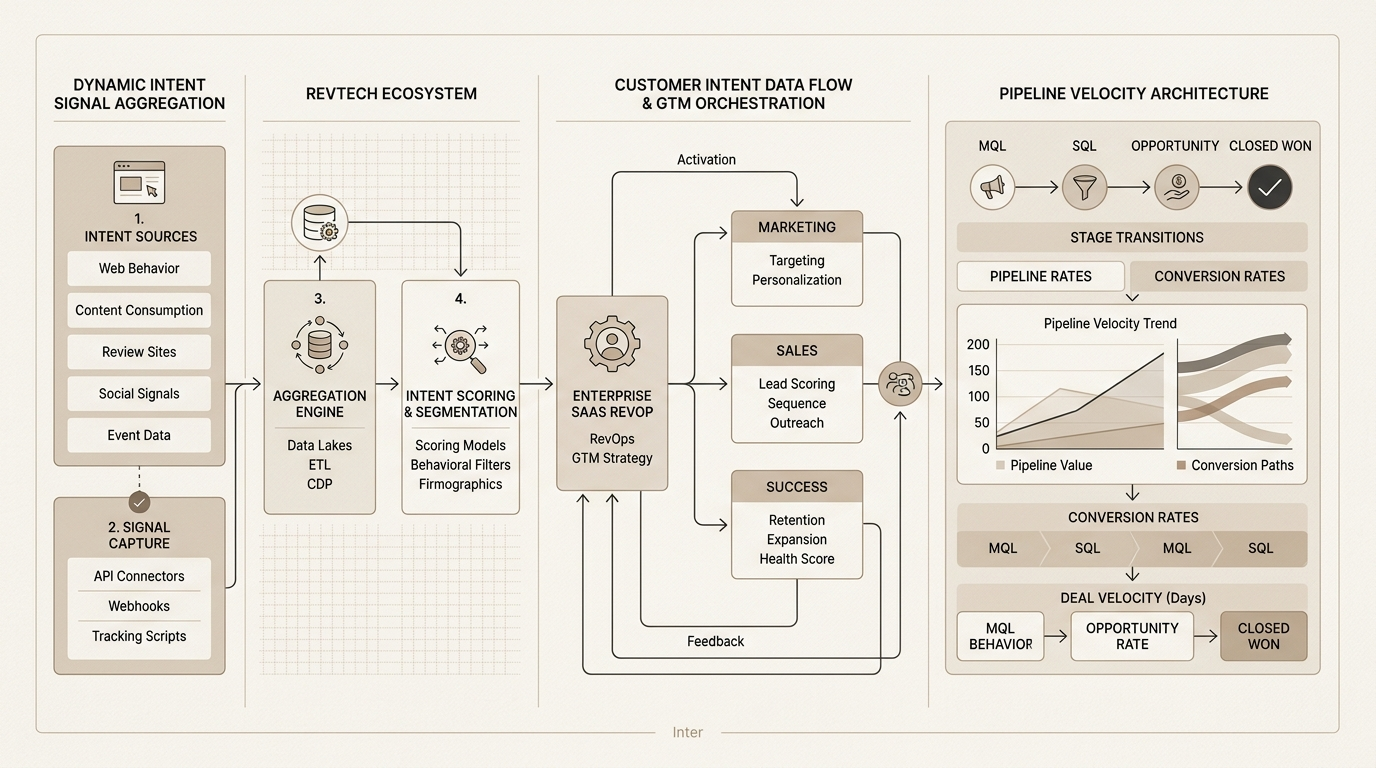
To eliminate the friction of legacy qualification gates, top-quartile SaaS engines are shifting from single-contact lead scoring to Dynamic Signal Aggregation. Rather than waiting for an individual to hit an arbitrary point target, signal aggregation platforms ingest multi-threaded data clusters across entire organizations—combining first-party website visits, ungated documentation interactions, technographic stack changes, executive hiring signals, and third-party intent surges into a real-time account intent velocity score.
Data from Bessemer Venture Partners and OpenView SaaS Growth Benchmarks highlights a dramatic divergence in operational efficiency between legacy point-scoring organizations and signal-led GTM engines:
- 3.6x Higher Pipeline Conversion Velocity: Enterprise SaaS organizations that route real-time signal clusters (e.g., three concurrent technical doc visits + key executive hiring signal) directly to Account Executives convert discovery meetings to closed-won revenue at 3.6x the rate of traditional MQL-driven teams.
- 31% CAC Reduction: By eliminating cold SDR outbound cadences against dormant point-scored leads and concentrating resources on accounts exhibiting intent velocity spikes, top-quartile vendors achieve a 31% reduction in total Customer Acquisition Cost.
- 38% Shorter Sales Cycles: Signal-led RevOps engines equip sales representatives with full contextual awareness of a committee’s research history before the first conversation, shortening average enterprise deal cycles from 270 days down to 167 days.
Leveraging modern orchestration layers like Clay and HockeyStack, market leaders are automating signal ingestion, ensuring that sales outreach is triggered not by isolated form fills, but by true organizational momentum.
Executive Summary: The Operational Imperative
If I had to boil down what this data means for VPs of Marketing and Revenue Leaders looking at their growth models, it comes down to three operational imperatives:
- Abolish arbitrary point-based lead scoring: Sunset legacy point thresholds that qualify individual researchers and replace them with multi-threaded account intent velocity matrices.
- Re-architect RevOps around signal orchestration: Integrate signal ingestion layers directly into CRM workflows, enabling sales teams to act on real-time intent triggers like hiring shifts, technographic changes, and dark funnel engagement.
- Capture dark funnel mindshare through ungated value: Remove form gates from high-value research, architecture guides, and pricing models to build category authority long before formal procurement begins.
In the modern enterprise SaaS landscape, sustainable revenue growth is not built on the volume of outbound noise you generate, but on the depth of trust you earn when buyers are researching in silence.
Disclaimer: This article was created with the assistance of Artificial Intelligence tools to support research, structure, and editorial drafting, in full compliance with AI transparency principles and the EU AI Act.
