
For more than a decade, enterprise B2B SaaS Go-To-Market (GTM) executives have operated under a comfortable, highly reassuring fiction: that software buying decisions are neat, linear, and fully trackable. According to this traditional playbook, a prospect encounters a targeted search ad, downloads a gated whitepaper, attends a webinar, and is promptly converted into a Marketing Qualified Lead (MQL). From there, a predictable sequence of SDR touchpoints leads directly to an executive product demo and a signed enterprise contract. To validate this machinery, Chief Marketing Officers and Revenue Leaders have poured millions into Multi-Touch Attribution (MTA) software, assuming these dashboards provide an objective mathematical map of how pipeline is created.
Yet, as Customer Acquisition Costs (CAC) escalate by more than 40% across mid-market and enterprise SaaS sectors, and sales cycles stretch beyond 180 days, GTM leaders face a sobering reality—legacy attribution models are measuring digital activity, not buyer persuasion. By over-indexing on easily trackable digital interactions, SaaS organizations are actively starving their demand creation engines while funding a hyper-competitive, diminishing pool of active buyers.
The Fallacy of Linear Performance Marketing
The foundational flaw of modern demand generation lies in an existential confusion between demand capture and demand creation. Most performance marketing budgets are designed to capture buyers at the exact instant they raise their hands on software review platforms or search engines. Modern GTM teams treat these lower-funnel touchpoints as the beginning of the buyer journey. In truth, hand-raising is merely the final, administrative step of an evaluation process that occurred almost entirely out of sight.
Groundbreaking market research from Gartner and McKinsey & Company demonstrates that up to 83% of the B2B purchasing journey takes place completely independent of vendor interactions. Furthermore, extensive longitudinal research by the LinkedIn B2B Institute confirms the 95/5 rule: at any given moment, only 5% of target enterprise accounts are actively in-market to buy software. The remaining 95% of target accounts are out-of-market, focused on execution, internal workflows, or budget constraints. Despite this distribution, SaaS benchmark data indicates that enterprise organizations allocate over 75% of their performance marketing budgets exclusively toward capturing that 5% active buyer pool. The result is a costly bidding war for last-click keywords that inflates CAC while leaving 95% of potential future market revenue untouched.
The Dark Funnel and Pre-Funnel Buyer Autonomy
When enterprise buying committees do enter an active procurement cycle, their actual research behavior bears no resemblance to traditional CRM funnel stages. Modern enterprise software purchases now involve an average of 11 to 13 distinct decision-makers—spanning IT security, finance, end-user leads, and executive sponsors—each conducting autonomous research.
Comprehensive buyer behavior benchmarks from 6sense and Demandbase reveal that 84% of B2B SaaS buying decisions are effectively established before a prospect ever completes a web form or speaks with a sales representative. Buying committees evaluate software solutions across un-trackable “dark funnel” environments: private Slack communities, peer referral networks, industry podcasts, dark social discussions, and un-gated technical documentation. By the time an inbound request lands in Salesforce or HubSpot, the buying committee has already curated their vendor shortlist, established pricing expectations, and formed strong brand biases. Vendors not pre-selected during the 95% out-of-market phase are rarely considered, regardless of how aggressively they bid on lower-funnel search terms.
Multi-Touch Attribution: Measuring Noise, Missing Signal
If legacy performance marketing is so fundamentally misaligned with buyer behavior, why do revenue leaders continue to justify massive spend on lower-funnel capture? The culprit is the persistent reliance on Multi-Touch Attribution software. MTA software was built for an era of simple web analytics, operating on the flawed premise that every digital touchpoint can be tracked, weighted, and assigned dollar revenue credit.
An exhaustive multi-touch attribution analysis conducted by HockeyStack and Dreamdata—analyzing over $1.2 billion in anonymized B2B SaaS pipeline across enterprise vendors—exposes a profound measurement disconnect. The data shows that first-touch software review site clicks and paid search conversions account for less than 12% of actual closed-won Annual Recurring Revenue (ARR) influence. Conversely, un-trackable dark social engagements, organic brand searches, and direct visits to product documentation drive over 68% of enterprise pipeline velocity and deal progression.
Because software review sites and paid search ads leave clear digital breadcrumbs, software attribution models assign them outsized credit. Meanwhile, the dark social conversations and un-gated content that actually build buyer consensus remain invisible. Consequently, CMOs are incentivized to double down on measurable, low-impact channels while cutting funding for high-impact brand building and category authority.
Building a Signal-Based Revenue Operations Engine
To break free from the attribution trap, forward-thinking Revenue Operations and GTM leaders are abandoning reactive lead scoring in favor of signal-based demand creation engines. Benchmark data from Bessemer Venture Partners and OpenView SaaS Benchmarks reveals that top-quartile SaaS companies—those maintaining 50%+ year-over-year ARR growth—allocate over 60% of their GTM capital toward brand affinity, un-gated research, and signal-based demand creation. As a result, these high-performing organizations achieve 4.2-month shorter CAC payback periods and enjoy 35% higher win rates against competitors relying on reactive lead generation.
Transitioning to a signal-driven GTM model requires three structural operational shifts:
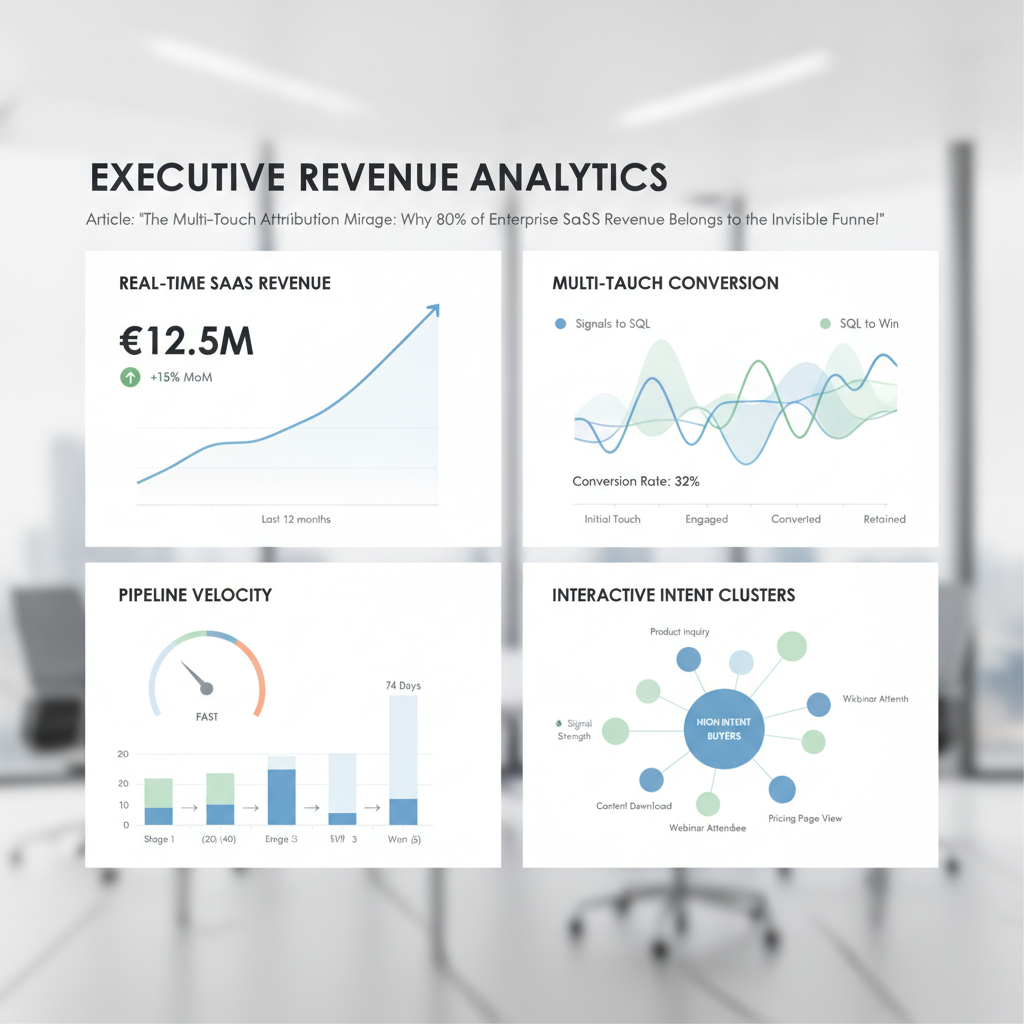
- Shift 1: Replace MQL Lead-Scoring with Account Intent Clusters. Move away from arbitrary point systems that award “MQL status” for downloading a single PDF. Utilize advanced RevOps platforms like Factors.ai and Clay to synthesize multi-threaded intent signals—such as job postings, technology stack changes, and aggregated dark funnel research—to identify when entire target accounts exhibit buying intent.
- Shift 2: Treat Product Content as Un-Gated Infrastructure. Dismantle lead capture gates on whitepapers, research reports, and technical documentation. When you un-gate content, you maximize buyer mindshare during the 95% out-of-market phase. When those accounts finally enter a buying window, your platform is already established as the default industry benchmark.
- Shift 3: Empower Sales Development with Real-Time Intent Context. Outbound SDR teams must cease cold demographic outreach based on static contact lists. Equip sales reps with real-time intent triggers—such as repeated documentation visits by enterprise IP addresses or leadership transitions—enabling reps to initiate high-value, consultative conversations when accounts are genuinely receptive.
Executive Takeaway: The Shift to Sustainable SaaS Growth
If I had to boil down what this data means for VPs of Marketing and Revenue Leaders looking at their GTM strategies, it comes down to three operational imperatives:
- Abandon the last-click attribution trap: Reallocate capital toward brand equity, dark social mindshare, and un-gated buyer education so your product is the pre-selected favorite when out-of-market accounts enter a buying cycle.
- Replace MQLs with first-party signal intelligence: Shift RevOps focus from superficial form fills to account-level intent clusters, evaluating GTM efficiency through pipeline velocity and CAC payback rather than lead volume.
- Unify Sales and Marketing around real-time buyer signals: Empower SDRs and account executives to engage accounts based on meaningful intent triggers during their invisible research phase rather than waiting for an inbound form submission.
In the modern B2B SaaS landscape, sustainable category leadership is not won by the company that spends the most on the final click, but by the brand that earns the buyer’s unshakeable trust long before a sales rep is ever invited to the table.
Disclaimer: This article was created with the assistance of Artificial Intelligence tools to support research, structure, and editorial drafting, in full compliance with AI transparency principles and the EU AI Act.
