
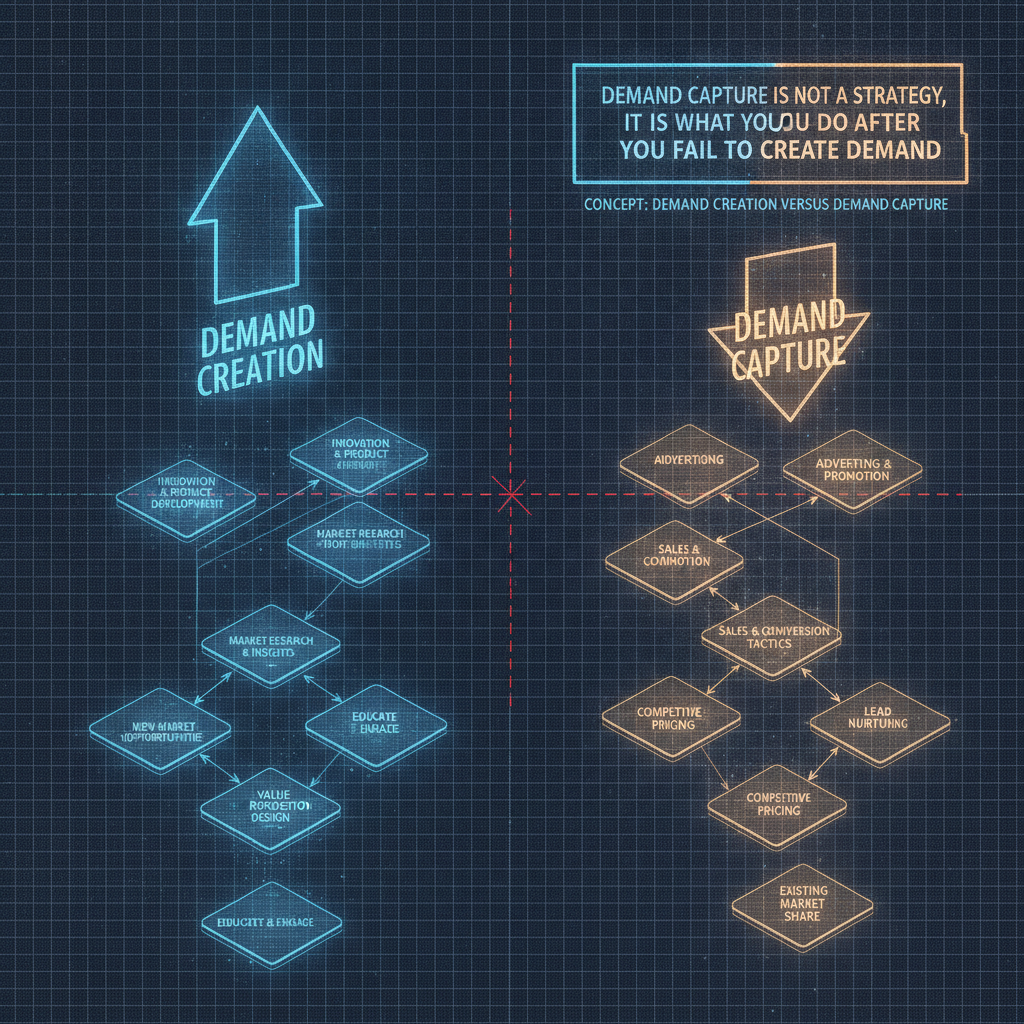
Demand Capture Is Not a Strategy, It Is What You Do After You Fail to Create Demand
Most B2B SaaS marketing teams call demand capture their strategy. It is not. Demand capture is the fallback move for markets where nobody built the demand in the first place, and treating it as a strategy is why so many pipelines are full of people who were already looking, and empty of the ones who did not know they had a problem yet.
What Is Demand Capture and Why Does It Matter for B2B SaaS?
Demand capture is the set of tactics used to convert existing, already-formed buyer intent into pipeline, while demand creation is the work of generating that intent in buyers who were not yet actively searching for a solution. SEM, bottom-funnel SEO, retargeting, and intent-data outbound all sit under demand capture. They are efficient, measurable, and almost entirely dependent on someone else having already done the harder job of making the category, and your brand within it, worth searching for.
The confusion matters because most B2B SaaS marketing budgets are allocated as if capture were the whole job. [Insert Stat/Case Study here: percentage of B2B SaaS marketing budget typically allocated to capture channels versus creation channels].
How Understanding This Distinction Solves the Flat Pipeline Problem
Teams that over-invest in capture eventually hit a ceiling, because capture channels can only convert demand that already exists. When search volume for your category plateaus, so does your pipeline, no matter how much you optimize the bottom funnel. Demand creation is what expands the addressable pool of people who will eventually search.
Rebalancing toward creation gives marketing teams:
- A pipeline source that is not capped by existing search volume, because you are building intent, not just harvesting it
- A defensible moat against competitors bidding up the same capture keywords, since creation builds brand preference before the buyer starts comparing vendors
- Better win rates in competitive deals, because buyers who arrive with brand familiarity convert at higher rates than pure capture leads
- A longer-term compounding asset, since creation content and category education keep working long after a single campaign ends
[Insert Stat/Case Study here: a B2B SaaS company that shifted budget mix toward creation and saw pipeline diversify beyond branded search].
Demand Capture vs. Demand Creation
- Buyer intent: Demand Capture = Already exists; Demand Creation = Does not yet exist, or is latent
- Primary channels: Demand Capture = SEM, bottom-funnel SEO, retargeting, intent data; Demand Creation = Thought leadership, category education, community, PR
- Time to pipeline: Demand Capture = Fast, days to weeks; Demand Creation = Slow, months to quarters
- Measurability: Demand Capture = High, direct attribution; Demand Creation = Lower, requires multi-touch or brand lift models
- Ceiling: Demand Capture = Capped by existing search volume; Demand Creation = Uncapped, expands the addressable market
Step-by-Step Guide to Rebalancing Toward Demand Creation
- Audit your current spend by intent type, tagging every channel and campaign as capture or creation, not by channel name alone.
- Identify your capture ceiling, by tracking whether branded and bottom-funnel search volume has plateaued over the last two to four quarters.
- Define a creation thesis, a specific point of view or category reframe your brand is willing to own publicly and repeatedly.
- Fund creation with a protected budget line, separate from performance marketing, so it does not get cut the first time a quarter runs tight.
- Measure creation on leading indicators, branded search growth, unaided awareness, and share of voice, not last-touch pipeline attribution.
Key Challenges and How to Overcome Them
The hardest part is patience. Demand creation does not show up in a 30-day attribution window, and CFOs tend to fund what they can measure this quarter. The fix is reporting creation and capture separately, with different KPIs and different timelines, so creation is not judged by capture’s rules. The second challenge is internal, since sales teams often push back on creation spend because it does not generate immediate leads. Framing creation as pipeline insurance for the next two quarters, not a replacement for capture, tends to reduce that friction.
Conclusion and Next Steps
Demand capture will always be part of a healthy B2B SaaS marketing mix, but it cannot be the whole strategy, because it only converts demand someone else already created. If your pipeline growth has flattened even as capture spend increases, that is the signal your market’s existing intent pool is not growing fast enough to sustain you. Start by auditing your last two quarters of spend by intent type, not by channel, and see how lopsided the split really is.
