
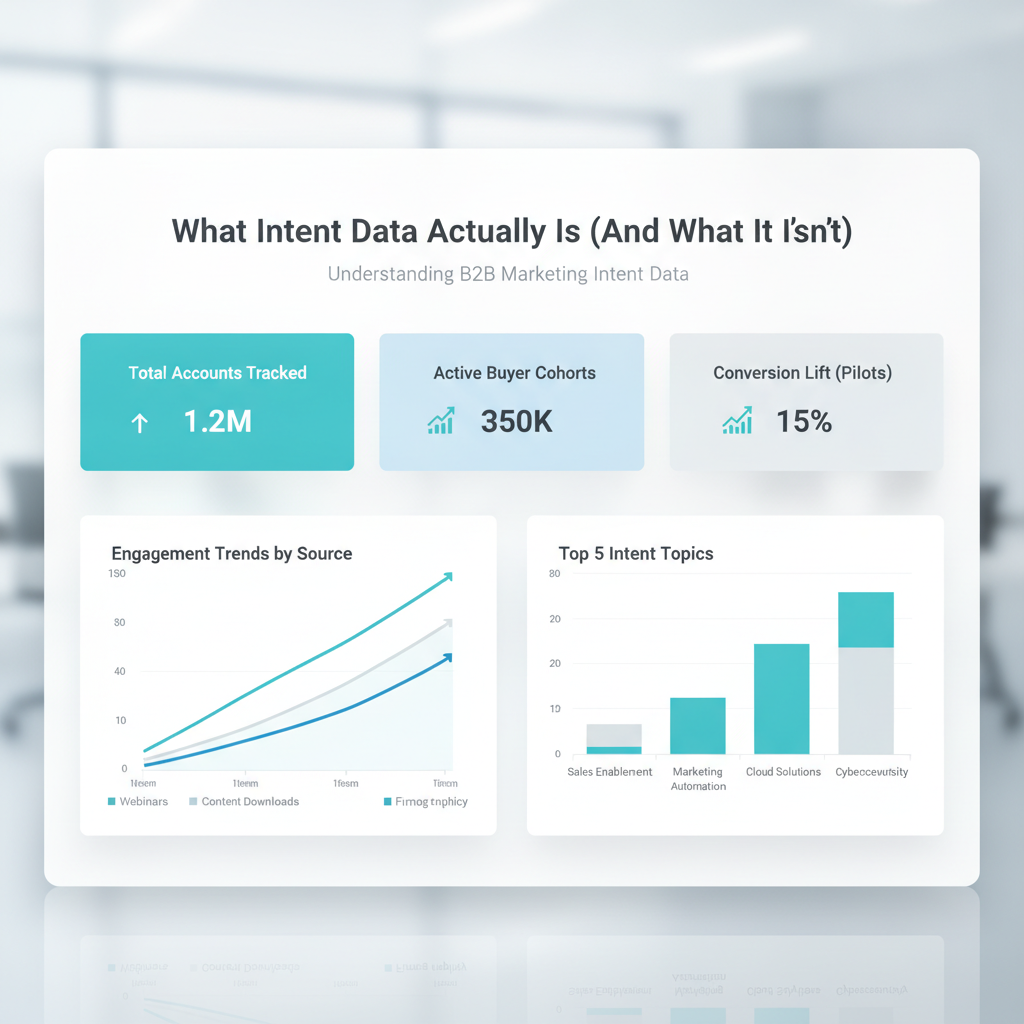
What Intent Data Actually Is (And What It Isn’t)
Everyone in B2B marketing says “intent data” now. Almost nobody uses it correctly.
Let me start with what it isn’t. Intent data is not retargeting with better branding. If your definition of signal-based marketing is “we serve ads to people who visited our website,” you’re still running a volume play, just with a smaller, slightly warmer audience. That’s optimization, not transformation.
Intent data is also not a lead score. A lead score tells you how engaged one person is with your content. Intent data tells you whether an entire account, often including people who have never touched your website, is actively researching a category your product solves for. Those are fundamentally different units of measurement, and conflating them is where most ABM programs quietly fail.
Here’s the real definition. Intent data aggregates behavioral signals, content consumption on third-party publisher networks, search behavior around category-specific keywords, review site activity, competitor comparison research, and technographic changes, then maps those signals back to a company, not a person. The output isn’t “John Smith is interested.” The output is “Account X has a buying committee actively researching this category, and here is the topic cluster they’re researching.”
That distinction matters enormously for how you build campaigns. A person-level signal tells you who to email. An account-level signal tells you which fifteen accounts deserve a coordinated, multi-channel play across paid, email, direct mail, and sales outreach, timed to when the buying committee is actually forming an opinion.
There are three categories of signal worth separating, because teams often treat them as interchangeable when they answer completely different questions.
First-party signals come from your own properties: pricing page visits, product page depth, content downloads, webinar attendance. These are the highest fidelity signals you have, because you know exactly which account and which behavior triggered them. The problem is coverage. First-party signals only capture accounts that are already aware of you, which is a fraction of your total addressable market.
Third-party intent signals come from data cooperatives and publisher networks tracking research behavior across the web, often before a company has ever visited your site. This is where the real leverage is, because it surfaces in-market accounts you wouldn’t otherwise know about. The tradeoff is precision. Third-party signals are probabilistic, not deterministic, and treating a spike in third-party intent as equivalent to a demo request is a fast way to burn sales trust.
Technographic and firmographic signals tell you about fit and change events: a company adopting a complementary technology, a leadership change, a funding round, a hiring surge in a relevant department. These signals don’t tell you intent directly, but they tell you when an account’s likelihood of being in-market shifts, which is often the earliest trigger available.
The mistake I see most often is teams buying a single intent platform, treating every signal it surfaces as equally actionable, and routing all of it straight to sales as if it were a hand raise. Sales burns out fast when half their “hot leads” are third-party signals with no first-party corroboration. Trust erodes, and the whole program gets written off as noise within two quarters.
The fix is a tiering model. Third-party signals should trigger top-of-funnel account-based advertising and content nurture, not a direct sales outreach. First-party signals combined with a third-party spike should trigger a coordinated multi-channel play. First-party signals with multiple stakeholders engaging should be the only tier that goes straight to an SDR with full context.
This is the part that separates operationally mature ABM from a dashboard full of intent scores nobody acts on correctly. It’s not about having the data. It’s about building the routing logic that turns a probabilistic signal into the right action, at the right velocity, for the right team.
There’s a related mistake that compounds this one: treating every intent vendor’s scoring methodology as interchangeable. They aren’t. Some platforms weight publisher network activity heavily, which surfaces broad category research early but with lower precision. Others lean on bidstream and cookie-based signals, which are shrinking in reliability as privacy regulation tightens across European markets. A signal score of 85 from one vendor and a signal score of 85 from another can represent completely different underlying behavior. If you’re running ABM across multiple markets, this matters even more, because coverage and data quality vary significantly by region. Third-party intent coverage that looks solid in the US market can be thin in smaller European markets, simply because there’s less publisher and search volume feeding the model.
This is why I never recommend building a program around a single intent signal source, especially in multi-market operations. Layering first-party behavioral data with at least one third-party intent source, and cross-referencing both against firmographic fit, produces a materially more reliable prioritization model than any single feed on its own. The redundancy isn’t waste. It’s the only way to catch false positives before they burn an SDR’s time on an account that was never actually in-market.
The last thing worth naming clearly: intent data decays fast. A signal that was accurate two weeks ago can be stale today, especially for shorter sales cycles. Programs that pull a signal report monthly and build campaigns off it are already working with outdated information by the time the campaign launches. The operational cadence has to match the decay rate of the signal itself, which for most B2B categories means weekly, not monthly, review cycles.
One more distinction worth making. Signal-based marketing is not the same as personalization. Personalization changes the message. Signal-based marketing changes the target list and the timing. You can have beautifully personalized content going to accounts with zero buying intent, and you’ll still miss your number. Get the targeting and timing right first. Personalization amplifies a good targeting decision. It doesn’t fix a bad one.
If your team already has an intent data subscription, ask this before your next planning cycle: can you draw the line, in one sentence, between a signal that triggers advertising and a signal that triggers an SDR call? If you can’t, you don’t have signal-based marketing yet. You have a very expensive dashboard.
Visual suggestion: a simple pyramid or funnel diagram showing the three signal tiers, third-party, first-party, first-party plus multi-stakeholder, mapped to the corresponding action, advertising, nurture, direct sales outreach.
This article was created with the assistance of artificial intelligence, in compliance with the EU AI Act.
