
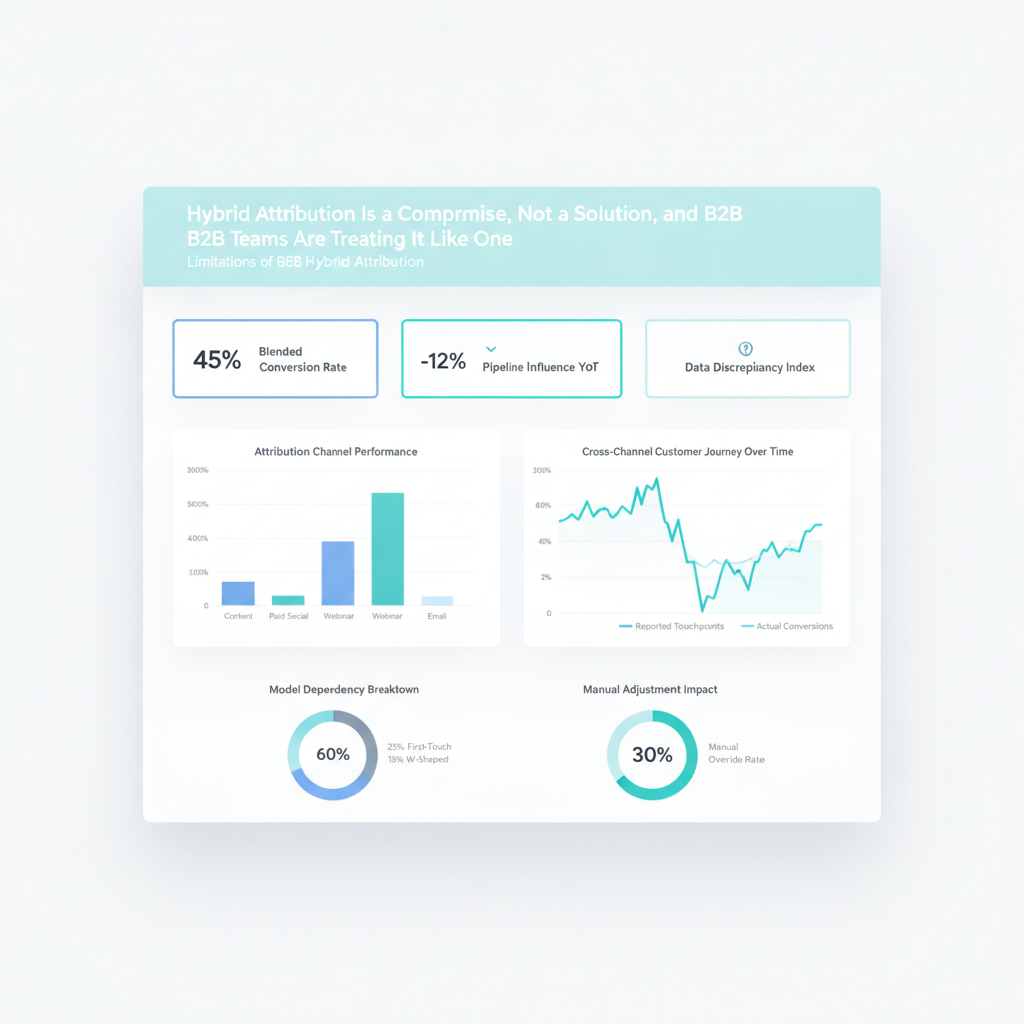
Hybrid Attribution Is a Compromise, Not a Solution, and B2B Teams Are Treating It Like One
By Gaetano Romeo, Head of Global Digital Marketing, EasyVista
Hybrid attribution has become the answer everyone gives when asked how they measure marketing performance in 2026. Multi-touch attribution for tactical decisions, marketing mix modeling for strategic budget, incrementality testing to validate the biggest spend lines. It sounds rigorous, and compared to single-touch models it genuinely is an improvement. What it isn’t, despite how it’s usually presented in a leadership deck, is a solved measurement problem.
The Adoption Numbers Look Like Progress
Multi-touch attribution adoption reached 47% in 2026, up from 31% in 2023, and roughly 33% of B2B teams now run an explicit hybrid MTA plus MMM model, treating multi-touch as the answer to “which campaign drove this opportunity” and marketing mix modeling as the answer to “what’s the marginal return on this channel at current spend.” Companies making the switch from single-touch to multi-touch report 15 to 30% CAC reduction and up to 40% ROI improvement, with some discovering that 60% of spend had been misallocated under the old model.
Those are real gains. They’re also gains relative to a genuinely bad baseline, single-touch attribution, not evidence that hybrid attribution has closed the measurement gap.
The Gap That Doesn’t Close
Here’s the number that gets buried under the adoption statistics: the dark-funnel gap, the share of the B2B buyer journey attribution systems simply cannot see, sits at a median of 38%, and that figure has held steady even as hybrid adoption has climbed. Nearly 90% of B2B teams report struggling with attribution because of siloed systems, marketing automation, CRM, ad platforms, web analytics, and sales engagement tools each tracking a different slice of the same buyer with inconsistent identity resolution across devices and sessions.
Even within multi-touch attribution specifically, adoption reaching 47% doesn’t mean 47% of teams have accurate measurement. Only about 18% of multi-touch implementations are rated as highly accurate by the teams running them. And a separate survey found that while 85% of marketers are confident they measure holistic ROI, only 32% are actually doing genuine holistic cross-channel measurement. That’s a 53-point gap between confidence and reality, and it’s the exact gap hybrid attribution is supposed to close but, by the data, mostly doesn’t.
Why the Compromise Framing Matters
Multi-touch attribution and marketing mix modeling aren’t actually measuring the same thing with different methods, they’re answering structurally different questions with different failure modes, and stacking them doesn’t eliminate either failure mode, it just runs them in parallel. Multi-touch attribution systematically under-credits channels that build awareness and over-credits channels that close, a distortion that gets worse, not better, the longer and more distributed the buyer journey becomes. With the average B2B journey now running 272 days, 88 touchpoints, and 10 stakeholders, that distortion is compounding at exactly the moment hybrid models are being sold as the fix for it.
Marketing mix modeling solves the awareness under-crediting problem at a strategic level, but it operates on aggregate spend and outcome data, not individual touchpoints, so it can tell you channel-level marginal returns without ever being able to explain which specific campaign or piece of content influenced a specific deal. Incrementality testing, the third leg of the stool, is genuinely the closest thing to ground truth, but it requires holdout groups, meaningful test duration, and enough volume to reach statistical confidence, conditions most B2B SaaS companies, with far lower deal volume than the consumer brands incrementality testing was originally built for, simply don’t meet reliably at the channel level.
What “Hybrid” Actually Delivers, Honestly Stated
Companies running an AI reconciliation layer between MTA and MMM report roughly 22 percentage points higher holdout accuracy than either method alone, which is a genuine improvement worth having. But 22 points of improved accuracy on top of a baseline that was frequently unreliable to begin with is not the same claim as “we now know what’s working.” It’s closer to “we’ve reduced, not eliminated, how wrong we are.”
What I’d Actually Recommend Doing With This
- Stop presenting hybrid attribution internally as a solved problem. State the dark-funnel gap explicitly, at a median 38%, as a permanent planning constraint, not a temporary limitation waiting for better tooling.
- Reserve incrementality testing for your highest-spend channels only, where the volume exists to reach real statistical confidence, rather than trying to run it across every line item and generating false precision.
- Weight marketing mix modeling more heavily for annual strategic allocation decisions and multi-touch more heavily for quarterly tactical optimization, matching each method to the question it’s actually capable of answering rather than asking either to do the other’s job.
- Build reporting that shows a confidence range, not a single attributed number, for any channel operating primarily in the 81% of the buyer journey that happens before pipeline entry.
The Honest Version of “We’ve Solved Attribution”
No B2B SaaS company running hybrid attribution in 2026 has actually solved the measurement problem, they’ve made a well-documented set of tradeoffs and reduced, not eliminated, a well-documented gap. That’s a genuinely useful place to be. It’s also worth saying plainly in the leadership meeting, because a team that believes hybrid attribution gave them certainty makes worse decisions than a team that knows exactly how much uncertainty they’re still carrying.
Sources:
- B2B Marketing Attribution in 2026: The Complete Guide to Multi-Touch, MMM, and Method Stacking, Improvado
- Marketing Attribution Statistics 2026: 140 Data Points, Digital Applied
- Marketing Attribution Statistics (2026): 54+ Data Points, Omnibound
- Incrementality Measurement Guide (2026), SegmentStream
- The B2B Intent Data Attribution Methodology Reference 2026, FL0 Journal
[🤖 Co-created with the assistance of AI / Written in alignment with EU AI Act transparency guidelines]
