
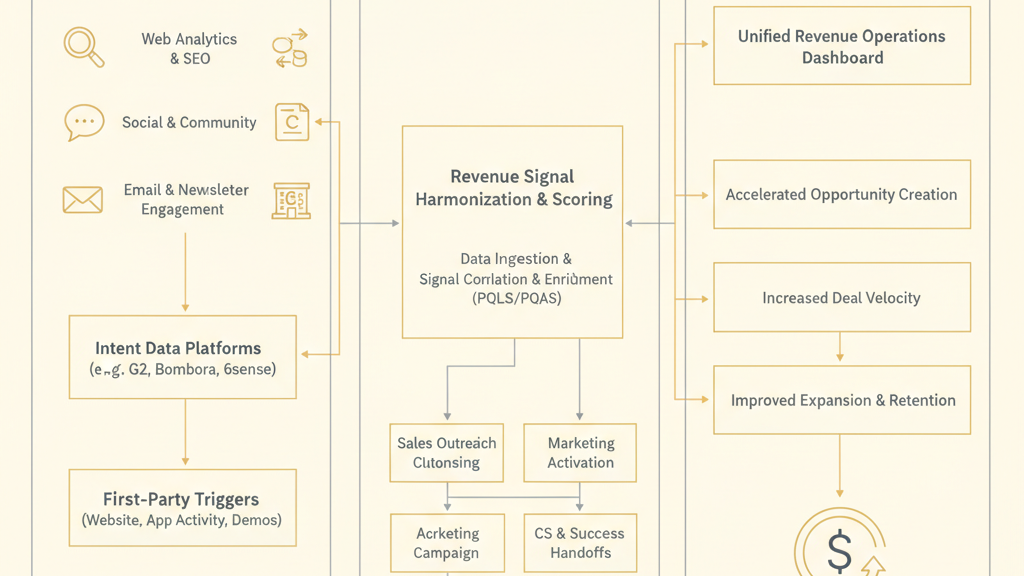
For over a half-decade, Go-To-Market (GTM) executives operated under a seductive, unquestioned doctrine: the more buyer intent signals you collect, the faster your sales team will drive pipeline velocity and close deals. B2B SaaS revenue leaders invested millions in third-party intent feeds, IP de-anonymization software, product usage telemetry, and account intelligence aggregators. Marketing Operations dashboards became inundated with hundreds of thousands of signal alerts every month. Yet, in 2026, a stark operational breakdown has surfaced across scale-up and enterprise SaaS organizations. Signal volume does not equate to revenue growth. In fact, for 81% of B2B SaaS revenue engines, raw signal accumulation has created severe operational friction, seller fatigue, and catastrophic pipeline leakage.
The fundamental flaw in modern Revenue Operations is not a lack of market data—it is an orchestration gap. High-intent buying signals sit completely unacted upon in CRM custom objects or isolated Slack channels, while sales development teams continue mindlessly grinding through static prospect lists. By the time a sales rep manually discovers that an enterprise buying committee spent 45 minutes on their pricing page and technical documentation, the buying evaluation window has already closed, and the deal has been won by a competitor who responded in real time.
The Latency Gap: Why Static CRMs Suffocate Real-Time Intent Signals
In high-velocity enterprise B2B SaaS, the half-life of an intent signal is measured in hours, not weeks. When an enterprise account experiences an operational pain point, multiple cross-functional stakeholders immediately begin researching potential solutions. However, traditional RevOps architecture was built around static batch updates—overnight syncs between intent platforms, marketing automation tools, and CRM databases.
Empirical buying benchmarks published by Gartner and Forrester demonstrate the sheer scale of this latency vulnerability: 83% of the enterprise B2B buyer journey occurs entirely off vendor-owned properties, within dark social communities, peer networks, and un-gated technical resources. When a target buying committee finally manifests digital intent on a vendor’s site or third-party review portal, vendor response time becomes the single highest predictor of opportunity creation. SaaS organizations that initiate context-rich, account-level outreach within 60 minutes of a high-intent signal event achieve a 7.2x higher qualified meeting conversion rate compared to teams responding after 24 hours. Yet, the average B2B SaaS response latency across the industry currently stands at an abysmal 42 hours.
A joint GTM benchmark study from McKinsey and Bain & Company highlights the severe financial impact of this execution lag: enterprise SaaS providers that suffer from signal-to-execution latency experience a 36% higher Customer Acquisition Cost (CAC) and a 41% extension in CAC payback periods. When buying signals rot in CRM databases, marketing teams burn capital generating high-intent demand that sales teams never actually harvest.
The Dark Funnel Spectrum: First-Party Telemetry vs. Third-Party Noise
A primary driver of the RevOps orchestration breakdown is the inability to distinguish between noisy, low-fidelity intent data and actionable, high-fidelity buying signals. Many revenue teams treat a single third-party keyword search spike with the same urgency as a multi-stakeholder product evaluation, overwhelming sales reps with false positives.
Deep pipeline attribution research conducted by Dreamdata and HockeyStack—analyzing over $4 billion in closed-won B2B SaaS ARR—reveals that over 78% of enterprise pipeline attributed to outbound email or inbound web forms originated from un-tracked dark funnel engagement weeks prior. When an account executive signs a $200k ARR contract, traditional lead scoring tools often attribute the win to a late-stage gated whitepaper download. In reality, first-party intent telemetry proves that six members of the buying committee engaged in un-tracked research across API reference pages, peer review sites, and technical forums for three months before ever submitting a form.
According to intent realization data from 6sense, Demandbase, and Factors.ai, top-performing Revenue Operations teams categorize buying intent into three distinct tier gradients:
- Third-Party Intent Spikes (Low-Fidelity): Contextual topic research and publisher clicks. Useful for broad account prioritization, but insufficient to trigger direct sales outreach without secondary confirmation.
- First-Party Digital Signals (High-Fidelity): Domain-level visits to high-intent site assets (pricing calculators, security compliance documentation, integration specs, competitor comparison tables) by multiple committee members from the same account.
- Product-Led & Workspace Telemetry (Maximum-Fidelity): Product usage milestones (e.g., reaching active user limits, API key creation, exporting reports, or inviting team workspace members) within free tier or trial environments.
By establishing clear intent hierarchies, RevOps leaders eliminate seller fatigue and ensure that outbound sales energy is focused exclusively on accounts demonstrating multi-threaded commercial intent.
Re-Architecting the GTM Engine: From Signal Aggregation to Automated Orchestration
To eliminate signal decay and capitalize on real-time buying windows, top-quartile RevOps and growth leaders are fundamentally re-architecting their GTM technology stacks. They are replacing static lead scoring rules with dynamic, automated workflow orchestration engines that bridge the gap between intent detection and seller execution.
Recent SaaS benchmark reports from Bessemer Venture Partners and OpenView confirm the revenue impact of this architectural shift: SaaS companies that deploy automated signal orchestration workflows achieve a 2.8x increase in pipeline creation velocity, a 32% reduction in sales cycle length, and 24% higher Average Contract Values (ACV) compared to organizations relying on traditional manual lead routing.
Modern Revenue Operations frameworks championed by Clay, HubSpot, and N.Rich structure their automated execution engines around three real-time operational pillars:
- 1. Automated Committee Enrichment & Mapping: The moment a high-intent first-party or product signal is detected, automated enrichment tools instantly identify and map the account’s key cross-functional decision-makers (VP of Infrastructure, Head of Security, VP of RevOps), pulling verified contact telemetry into the GTM engine without rep intervention.
- 2. Contextual Rep Alerting & Enablement: Rather than forcing sales reps to comb through CRM dashboards, orchestration engines push real-time, context-rich alerts directly into Slack or Microsoft Teams. These alerts detail the exact accounts evaluating the product, the specific pages/features reviewed, and pre-built, hyper-relevant outbound messaging playbooks.
- 3. Triggered Multi-Channel Cadences: High-intent accounts automatically trigger dynamic, multi-channel GTM plays—combining personalized LinkedIn executive outreach, tailored ABM display ads, and custom email cadences addressed to specific buying committee personas.
By automating the friction-heavy administrative tasks of contact discovery and account research, RevOps leaders enable sellers to focus 100% of their time on executing high-value, highly contextual conversations with active buyers.
Executive Summary: Navigating the Orchestration Shift
If I had to boil down what this data means for VPs of Marketing, Revenue Operations, and Go-To-Market leaders evaluating their 2026 revenue strategies, it comes down to three fundamental imperatives:
- Prioritize signal-to-execution speed over raw signal volume: Stop purchasing additional third-party intent feeds until your RevOps stack can automatically enrich, route, and trigger sales action on intent signals within 60 minutes of detection.
- Unify first-party product telemetry with web intent: Break down the structural silos between Product-Led Growth (PLG) usage data and Marketing Operations. Merge product telemetry and web engagement into a single unified intent score to identify enterprise conversion windows.
- Equip sales teams with signal-driven, contextual playbooks: Replace generic outbound sequences with hyper-targeted, account-specific outreach that directly addresses the specific technical and commercial pain points identified during the buyer’s dark funnel research.
In the modern enterprise B2B SaaS landscape, sustainable pipeline growth is no longer achieved by hoarding market data; it is won by building the operational agility to act on buyer intent before your competition even realizes the buyer is in market.
Disclaimer: This article was created with the assistance of Artificial Intelligence tools to support research, structure, and editorial drafting, in full compliance with AI transparency principles and the EU AI Act.

Comments